Quick Answer
Private safari is almost always better — but group safari makes sense in specific circumstances, and the price gap between the two is smaller than most people assume when you travel as two or more people.
The honest framing: private safari delivers a categorically different experience — a personal guide relationship, full schedule flexibility, and no compromises at sightings. Group safari delivers the same extraordinary wildlife at a lower upfront per-person cost, with fixed scheduling and shared decision-making. Neither format produces a bad safari for animal sightings. The difference is in pace, depth of experience, and personal connection to the journey.
Quick Facts: Private vs Group at a Glance
Private Safari
USD 250–700 per person per day — full vehicle and guide for your group
Group Safari
USD 200–350 per person per day — shared vehicle, fixed schedule
Group of 4 or more
Private cost approaches group cost — private usually wins the maths
Best for couples & families
Private safari strongly recommended — flexible pace, no strangers
Masatu Recommendation
Book private for your first-time Tanzania safari. You will see the parks, build your wildlife knowledge, and feel what the experience involves. If you later return for a shorter solo trip, you will have an informed basis to decide whether a group departure is acceptable.
The Core Difference
The entire choice comes down to two very different daily experiences.
Private Safari
A dedicated 4WD vehicle, typically a Toyota Land Cruiser, used exclusively by your group for the entire trip. Your guide is assigned to you personally and builds their approach around your interests. You set the daily rhythm: when you leave camp, how long you stay at each sighting, whether to change the afternoon plan because your guide heard a leopard report on the radio. The vehicle is your space — you spread out, you stand through the roof hatch when you want, and you don't manage anyone else's experience.
Group Safari
A joined-departure vehicle shared with 6–7 other travelers from different backgrounds, with different wildlife priorities, photography skills, and patience levels. The operator sets the schedule — fixed departure, fixed lunch stop, fixed return — and the guide manages the collective experience of 7 people simultaneously. The cost is spread across all passengers, making the per-person entry price the lowest available. It is fundamentally a social, budget-prioritised format.
What Private Safari Means Day-to-Day
Your own Land Cruiser, your own guide
The vehicle is configured for your group only. If you are two people, you have a 6-seat Land Cruiser to yourselves — room to move around, spread equipment, keep a seat for camera gear, and position yourself at every window. Your guide is not sharing their attention with 6 other people; they are focused entirely on creating the best possible experience for you.
You set the pace
Want to leave at 06:00 instead of 06:30 to catch the dawn? Done. Want to stay 90 minutes at a leopard in a tree? Done. Want to return to camp at 09:30 because one of your party isn't feeling well? Done immediately, without consulting anyone else or inconveniencing 6 other people. This flexibility is not a small luxury — it is the difference between a tailored experience and a managed group experience.
Change plans mid-drive
Your guide has a network of fellow guides communicating via radio throughout the day. If a cheetah is spotted stalking prey 8 km from your position, your guide can pivot immediately — no group vote, no competing priorities, no one to consult except you. On group safari, one person's desire to divert creates conflict with 6 other people's plans.
No strangers in the vehicle
For many travelers — particularly couples, honeymooners, and families — the privacy of a safari without strangers is simply important. Quiet moments watching an elephant family drink at dawn are different when shared with a full vehicle of people you met yesterday versus alone with your partner and a trusted guide.
What Group Safari Means Day-to-Day
Shared vehicle, fixed schedule
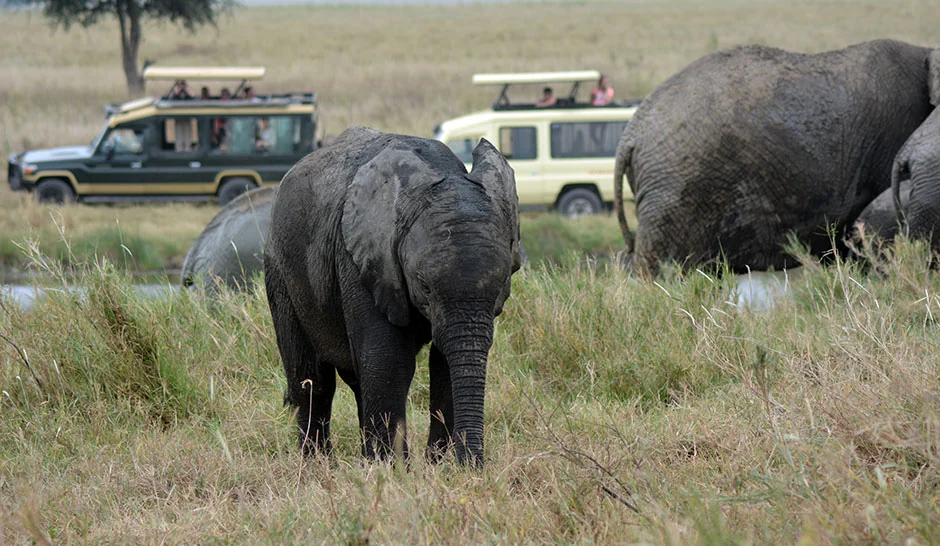
You will be collected with other travelers from your lodge or camp (sometimes from multiple lodges if the group is assembled from different starting points). The vehicle leaves on a schedule set by the operator, typically 06:30 for the morning drive. Lunch is at a fixed time at a specific location, and you return to camp when the schedule dictates.
Good for solo budget travelers
If you are traveling alone and your primary goal is the lowest possible cost, group safari is the answer. The per-person price on a group departure is genuinely the entry-level cost of a Tanzania safari — often USD 200–350/person/day including accommodation — far lower than the solo private rate of USD 450–700/day for the same vehicle occupied by one person.
The social aspect is real
Some travelers specifically value the group experience. Sharing the excitement of a lion kill with six new acquaintances from different countries creates bonds that many group-safari veterans describe warmly. If you enjoy meeting people and are comfortable with a shared experience, group safari can be genuinely enjoyable in a way that private safari is not.
Honestly: the wildlife is the same
The lions, elephants, and leopards don't know or care whether your vehicle is private or shared. If you genuinely don't care about pace, photography positioning, or schedule flexibility, you will see extraordinary wildlife on a group safari. The experience difference is real, but it lives in the texture of the journey, not in whether you encounter wildlife.
Side-by-Side Comparison
Ten factors that separate the two formats — at a glance.
| Factor | Private Safari | Group Safari |
|---|---|---|
| Vehicle | Only your booking party | Shared with 6–7 other travelers |
| Daily timing | Fully customisable, leave when you want | Fixed departure and return schedule |
| Route decisions | You and your guide decide together | Operator decides based on group consensus |
| Sighting stops | Stay as long as you want | Move on when group is ready (majority rules) |
| Comfort | Full vehicle for your group, more space | Shared seating, less personal space |
| Cost per person | Higher solo/couple; similar for group of 4+ | Lower per-person entry point |
| Family suitability | Excellent, essential for families with children | Difficult, fixed schedule conflicts with children's needs |
| Photography | High flexibility, position vehicle, stay as long as needed | Moderate, group pace limits positioning and time at sightings |
| Guide relationship | Personal, guide learns your interests and preferences | Shared, guide manages 7 different expectations simultaneously |
| Best for | Couples, families, photographers, milestone trips | Solo budget travelers; short trips; social travelers |
Cost Reality: Real Numbers
The cost gap between private and group closes significantly as your group size increases. Here are realistic per-person daily rates for a mid-range northern circuit safari (quality lodges, good guide, park fees included):
Private Safari Rates (per person/day)
Solo travellerUSD 450–700
Couple (2 people)USD 300–500
Group of 4USD 250–400
Group of 6USD 220–350
Group (Joined Departure)
Any group sizeUSD 200–350 pp/day
The typical gap between a couple on private safari vs the same couple on a group departure is USD 100–150/person/day.
On a 7-day safari that is USD 700–1,050 extra per person. Most couples who have done both say the experience difference is worth this premium.
The group-of-4 insight
A family or group of 4 on a private safari pays USD 250–400/person/day — within, or at the top end of, the group departure range, but with every benefit of a private vehicle and personal guide. For groups of 4+, choosing group departure over private is rarely financially justified once the per-person difference drops to USD 50–100/day or less.
Who Should Choose What?
Private is clearly better for:
Families with children. Non-negotiable. Fixed group schedules cannot accommodate children's needs. Private is the only format that works reliably with kids.
Honeymoons & milestone trips. Privacy and intimacy matter on anniversary and honeymoon trips. Sharing a vehicle with strangers undermines both.
Photographers with specific goals. You need to position the vehicle, stay at sightings as long as the action lasts, and make decisions based on light and subject behaviour.
Travelers with dietary or medical needs. Private scheduling allows flexibility around medical and dietary requirements that fixed group schedules cannot accommodate.
Groups of 3 or more. The per-person cost difference shrinks to the point where the choice becomes obvious. At 4 people the maths almost always favour private.
Group makes sense for:
Solo travellers prioritising cost. If you are alone and budget is the determining factor, a group departure achieves the lowest possible per-day cost.
Solo travellers who enjoy company. If you like meeting people from different countries and are genuinely flexible about schedule and pace, group safari can be a rewarding social experience.
Short trips (2–3 days). The premium for private on a 2-day trip is harder to justify than on a 7-day safari. A short group departure is a valid way to see Ngorongoro Crater at lower cost.
Experienced repeat safari goers. Some experienced travelers choose group for repeat, shorter trips where the wildlife is the focus and the logistical details matter less.
The Guide Relationship
This is the most underappreciated difference between private and group safari — and for many experienced travelers, the most important one.
Either way, the quality of your guide shapes the entire trip. Professional Tanzania safari guides train for years, pass stringent licensing exams, and are accredited through bodies such as the Tanzania Association of Tour Operators (TATO) — so on both private and shared vehicles, the difference is how the guide's attention is directed, not whether they are qualified.
On Private Safari: A Personal Guide Relationship
Your guide is assigned specifically to your group for the entire trip. By day two, they know what excites you most — whether it is predator behaviour, bird identification, elephant family dynamics, or finding rare sightings. They remember that you saw lions on day one and actively prioritise leopard on day two. They explain animal behaviour at the depth you want: more detail for curious travelers, a lighter touch for those who prefer to observe quietly. When you ask a question, you get a complete answer, not the abbreviated version appropriate for a mixed group with different levels of interest.
The guide relationship on a multi-day private safari often becomes the aspect guests remember most vividly — not just the animals, but the conversations, the explanations, and the specific knowledge shared over 6 hours of daily game driving. A good safari guide is an extraordinary person: expert naturalist, local ecological expert, skilled driver, patient teacher, and engaging storyteller. On private safari, all of that is directed exclusively at you.
On Group Safari: Managing 7 Different Expectations
A group safari guide is simultaneously managing 7 people with different levels of wildlife knowledge, different priorities (one wants birds, one wants big cats, one just wants to photograph everything), and different temperaments (one wants constant information, one wants silence, one wants to stop at every animal, one wants to keep moving). A good guide handles this gracefully, but there is an inherent compromise at the centre of every group drive that does not exist on private safari. No guide, however excellent, can give 7 people the individually tailored experience they would each receive on a private vehicle.
Hybrid Option: Semi-Private Safari
Some operators offer a semi-private format that sits between the two extremes — typically 2 to 4 travelers per vehicle rather than 6–7. This is not a standard product that all operators advertise, but many will arrange it on request.
Semi-private works well for solo travelers or couples who cannot stretch to fully private but want more than a standard group departure. With 2–3 people in a vehicle designed for 6–7, you gain significantly more personal space, more influence over the guide's attention and priorities, and a more flexible pace than a full group departure provides. The cost per person sits between group and fully private rates.
Ask your operator specifically: "Do you offer semi-private departures, or can you arrange a vehicle with a guaranteed maximum of 4 travelers?" The answer is often yes if you ask directly. For budget-conscious solo travelers and couples, semi-private is often the best compromise between cost and experience quality.
Frequently Asked Questions
For most travelers, yes — especially as a couple, family, or small group. The core experience of a private safari is fundamentally different: you have a personal relationship with your guide, you make decisions together in real time, and you can spend as long as you want at the sightings that matter most to you. On a group safari, you are one of 7 people with different interests, patience levels, and priorities. When a leopard appears in a tree 50 metres from your vehicle, the group experience is: a few photos, then move on, because the vehicle behind you is waiting. On private safari, you stay for 45 minutes watching the leopard until she decides to move. That difference is worth a lot.
Group safari makes genuine sense for solo travelers comfortable with strangers whose primary goal is cost minimisation. If you are traveling alone on a strict budget, a group departure brings the per-person cost to its lowest possible point. It also works well for people who specifically enjoy meeting other travelers — you share a vehicle with people from different countries for 6–7 days, and many find this genuinely enjoyable. If you don't care deeply about photography timing, are flexible about schedules, and want the lowest possible entry price, group safari is a valid choice — and the wildlife sightings are equally extraordinary.
Dramatically. Families with children on a group safari face structural incompatibilities: children need toilet breaks when they need them, not at scheduled stops. A child who has reached their limit at 9:30am cannot wait for the group's scheduled 10:30 return. Private safari eliminates all of these conflicts — your guide's job is to manage your family's day, full stop. Early return when the kids have had enough, extended stops when they are captivated by elephants at a waterhole, flexible meal timing, and toilet stops on demand. For families, private is not a luxury upgrade; it is a logistical necessity.
No — this is one of the most common misconceptions. 'Private safari' refers to your vehicle and guiding arrangement, not your accommodation level. You can book a private safari with budget camping, mid-range tented lodges, or ultra-luxury camps. The private element means your dedicated vehicle and guide; the accommodation level is a separate choice. The private/group decision and the accommodation level decision are independent of each other.
The gap is smaller than most people assume, and it shrinks dramatically as your group size increases. A solo traveller on private safari pays the full vehicle cost alone. A couple on private splits it two ways — the premium over a group departure is typically USD 100–200/person/day, which on a 7-day safari is USD 700–1,400/person. A group of 4 on private approaches group-departure per-person costs while enjoying every benefit of a private vehicle — often within USD 50–100/person/day, which is why most travelers in that position choose private without hesitation.
Sometimes possible in theory but very difficult in practice, particularly in peak season (July–October) when vehicles are pre-allocated weeks in advance. If you start on a group safari and want to switch, your operator may arrange a private vehicle for the remaining days if one is available, but do not count on it. It is far better to decide your format before confirmation. If you are genuinely uncertain, book a short trial (2–3 days) on private safari and see how it feels — almost no one who experiences private safari for the first time wishes they had chosen group instead.
A middle ground typically offering 2 to 4 people per vehicle rather than 6–7. You get more space per person, more influence over the daily pace, and a more personal guide relationship than a full group departure, while reducing per-person cost compared to a fully private vehicle. If you are traveling solo or as a couple and cannot stretch to fully private, semi-private is a genuine improvement over a standard group departure — ask your operator specifically, as not all offer it as a formal product.
Plan Your Safari with Masatu
When requesting quotes, always ask operators to provide both a private and group option side by side at the same lodge quality level. The direct comparison makes the decision straightforward: you can see the actual dollar gap for your group size and trip length, and judge whether the flexibility and experience premium is worth it for your circumstances.
How to Decide — Step by Step
Get Both Quotes
Request a private and a group quote side by side at the same lodge level — the gap is usually far smaller than expected.
Compare the Gap
Check the per-person difference for your exact group size and trip length before deciding.
Decide the Format First
Confirm private or group before you book. Switching mid-trip rarely works, especially in peak season.
Book Early if Private
Private vehicles at the best camps in peak season (July–September) can need 6–10 months of lead time; group departures can often be booked 2–3 months out.
Go Private on Your First Trip
Very few first-time visitors regret choosing private; many group first-timers wish they had gone private.
Tell us your group size, dates, and budget — we will send you both options side by side so you can see exactly what each format costs. Karibu sana, and welcome to Tanzania.
Helpful Resources
More Tanzania Safari Guides
6 GuidesAfrican Safari Cost
Complete safari cost breakdown
Tanzania Safari Cost for 2
Budget breakdown for couples
Is Tanzania Safari Safe for Families?
Safety tips for family safaris
What to Expect on a Safari
Your day-by-day safari experience
Tanzania Safari Tipping Guide
Who to tip and how much
Safari Guides
Meet our expert guides
Sources & References
- Tanzania Association of Tour Operators (TATO) – licensed safari operators and industry standards.
- Tanzania National Parks (TANAPA) – park fees, rules and the northern circuit parks.
- Tanzania Tourism Board – official travel guidance and tourism information.
Last updated: September 16, 2026. Prices, seasons and operator products can change — always confirm current rates and availability for your specific dates before you book.