Money in Tanzania is simpler than most travellers fear. The official currency is the Tanzanian shilling (TZS), cards work at most hotels and bigger restaurants, and ATMs are easy to find in Moshi, Arusha, Dar es Salaam, and Zanzibar. The few rules that matter, like carrying cash for markets and bringing crisp US dollars for exchange, are easy to learn.
The most important change is recent. Since March 2025, everyday domestic sales are made in Tanzanian shillings only. Tour operators and some lodges still invoice in foreign currency, but shops, taxis, and market stalls expect TZS. This guide covers everything: the notes and coins, cards and ATMs, where to exchange, how much cash to bring, and how to tip fairly.
Safari Guide's Note
The travellers who struggle with money in Tanzania are rarely the ones with the least cash. They are the ones carrying only large bills, expecting cards to work everywhere, or hoping to use yesterday's worn dollars. A mix of TZS for daily life, a card for hotels, and a little crisp USD for exchange covers every situation.
Quick Answers
Four numbers tell you almost everything you need to know about money in Tanzania:
TZS
Official currency code
10,000
Highest common banknote
25%
Of spend to carry in cash
10k
USD declaration threshold
Official Currency
Tanzanian shilling (TZS)
Best Cash to Bring
Crisp USD, post-2009, no marks
Cards
Visa and Mastercard widely accepted
ATMs
Dispense TZS only
Export Rule
TZS cannot leave the country
Declare Above
USD 10,000 in cash
Safari Driver Tips
$10-20 per day
Local Sales Rule
In TZS since March 2025
What Is the Currency?
The official currency of Tanzania is the Tanzanian shilling, known by its code TZS and as shilingi in Swahili. It is used across mainland Tanzania and Zanzibar, and it is what you will use for almost every daily transaction: coffee, taxis, market bargaining, park snacks, and tips.
Tanzanian Shilling Details
- Name: Tanzanian shilling (Swahili: shilingi)
- Code: TZS
- Subdivision: 100 cents (coins under 50 TZS are rarely used)
- Banknotes: from 1,000 TZS and above

You will mostly carry banknotes; coins are used for change on small purchases
Can I Use Cash in USD or EUR?
Not for everyday purchases. Since March 2025, cash payments in the domestic market are accepted in Tanzanian shillings only. Foreign currency still has its place, but it is for paying tour operators, some lodges, and exchange, not for buying a coffee.
Tourism Invoices
Tour operator contracts and some lodges can be paid in foreign currency. Masatu Tours quotes all prices in US dollars and accepts bank transfer, card, or PayPal.
USD and EUR Exchange
If you bring USD, use recent bills printed after 2009. Older or marked notes are often refused. Exchange USD or EUR for TZS at a bank or licensed bureau after arrival.
The Simple Strategy
Bring cards plus some USD or EUR for initial exchange, then convert to TZS once you arrive. Keep your everyday money in shillings and reserve foreign cash for paying your tour operator or an emergency.
Cards, ATMs, and Contactless Payments
Cards
- Visa and Mastercard accepted at most hotels and larger restaurants
- Amex acceptance is limited
- Always ask whether a card fee applies
- Carry a backup card from a different bank
ATMs
- Available in Moshi, Arusha, Dar es Salaam, and Zanzibar towns
- Dispense Tanzanian shillings only
- Typical limit of 200,000-400,000 TZS per transaction
- Expect local ATM fees plus your bank's FX fee
Pro Tip
Card machines sometimes add a local surcharge of around 3-4%. Notify your bank of your travel dates before you fly to avoid blocks, and keep a backup card separate from your main wallet.
Where to Exchange Money
Banks and licensed bureaux de change in city centres give the best rates. Airport kiosks are convenient but less favourable, so change only a small amount there to cover your first taxi or transfer.
Banks (Best Rates)
Transparent rates and safe. Look for bank branches in town centres for larger sums.
Airports (Convenient)
Rates are less favourable. Change only enough for a taxi or transfer on arrival.
Hotels (Poor Rates)
Will exchange money but usually offer poorer rates than banks. Fine for small top-ups.
Street Vendors (Avoid)
High risk of counterfeit notes and scams. Use trusted, official channels only.
How Much Cash to Bring?
Cards cover most big payments, but Tanzania still runs on cash for everyday life. Keep at least 25% of your expected spending in TZS, plus a small emergency fund in crisp USD.
Keep at least 25% of your expected spend in TZS for:
- Markets and street vendors
- Tips and small purchases
- Smaller cafes without card machines
- Remote location fees and guides
Declaring Cash & Restrictions
Cash Declaration
If you carry more than USD 10,000 (or the equivalent) in cash when entering Tanzania, you must declare it on arrival. This is a simple form, but failing to declare can lead to confiscation and fines.
TZS Export Rule
Exporting Tanzanian shillings is prohibited for non-residents. You cannot take TZS home, so spend or exchange any leftovers before departure. It is easy to avoid with a little planning.
Typical Prices
A rough guide so you know what is reasonable. Prices vary between Moshi, Arusha, Dar es Salaam, and Zanzibar, but these ranges give you a reliable sense of everyday costs.
| Item | Price in TZS |
|---|---|
| Bottle of water or soft drink | 1,000-5,000 |
| Coffee | 3,000-7,000 |
| Simple meal in a local cafe | 10,000-25,000 |
| Mid-range restaurant meal | 40,000-100,000 |
| Short taxi ride in town | Negotiate or ask for the meter |
Tipping & Small Payments
Tipping is customary in Tanzania, and small TZS notes make it easy. Masatu provides transparent tipping guidance for every trip and can handle collection and fair distribution for you.
Guides & Porters
For Kilimanjaro climbs, KPAP suggests $250-$300 per climber for a 7-day trek, shared across the crew. Safari drivers: $10-20 per day.
Restaurants
A service charge may already be included. If not, 5-10% in TZS is normal in sit-down restaurants.
Small Helpers & Baggage
1-3 USD (or the equivalent in TZS) is common for baggage and small favours. Small notes make this simple.
Climb Details
For full crew-by-crew amounts, read our Kilimanjaro Tipping Guide.
Banknotes & Coins
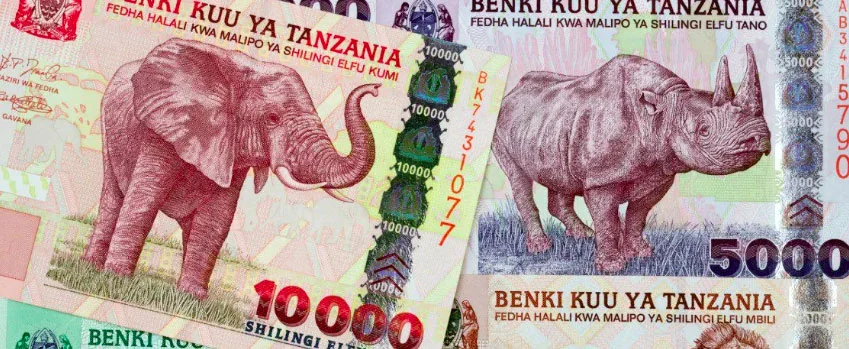
The commonly used notes are from the 2011 series. The 1,000 TZS note, in blue with a portrait of Julius Nyerere, is the note you will handle most. The 10,000 TZS note, in red with an elephant motif, is the highest denomination in everyday use.

Red 10,000, purple 5,000, orange 2,000, and blue 1,000 TZS notes are the everyday money
10,000 TZS - Red, elephant motif, highest common denomination
5,000 TZS - Purple or violet, black rhinoceros motif
2,000 TZS - Orange, lion motif
1,000 TZS - Blue, portrait of Julius Nyerere, the most common note
500 TZS - Exists but uncommon; coins cover 50, 100, 200, and 500 TZS
Avoid Counterfeits
Safety Guidelines
Use banks and licensed bureaux for exchange
Inspect big bills for security threads and clear printing
Decline unusually favourable rates offered on the street
Avoid very worn or damaged notes
Mobile Money & Electronic Payments
Mobile wallets such as M-Pesa, Tigo Pesa, and Airtel Money are how most Tanzanians pay for daily life. Contactless card payments are also growing at hotels and shops.
For Tourists
Using mobile money requires a local Tanzanian SIM and registration, which is not always convenient for short visits. Some lodges and guides accept transfers to mobile wallets; check with Masatu in advance if you prefer this method.
Practical Tips from Masatu Tours
Notify Your Bank
Tell your bank your travel dates and countries to avoid card blocks. Carry two different cards from different banks if possible.
Emergency Fund
Keep a small emergency fund in recent USD notes stored separately from your TZS, useful for unforeseen costs.
Compare Exchange Rates
Use bank branches in town centres for larger sums and compare rates quickly between two bureaux.
Spend or Exchange Leftovers
You cannot take TZS out of Tanzania, so spend or exchange leftovers before you depart.
Download a Currency App
Apps like XE or OANDA give you up-to-date rates so you always know what a price really means.
Pre-Arrival Help
Masatu can arrange airport pickup and help you exchange cash on arrival, so your first evening is calm.
Frequently Asked Questions
Book Your Safari With Confidence
Once the money question is settled, the next step is choosing your itinerary. Every Masatu Tours safari includes expert guides, comfortable lodges, and wildlife-packed game drives, with clear pricing in US dollars and transparent tipping guidance.
Experience Tanzania with Masatu Tours
Browse our Tanzania safari packages and Kilimanjaro climbs. Pay by bank transfer, card, or PayPal in USD, and carry a little TZS for the journey. Our team handles the practical details so you can focus on the wildlife.
Conclusion
Money in Tanzania comes down to three habits: keep TZS for daily life, carry a card for hotels and bigger payments, and bring a little crisp USD for exchange. Follow the 25% cash rule, spend your shillings before you fly home, and you will never be caught short.
For more planning help, read our Tanzania visa guide, our Kilimanjaro tipping guide, and the safari packing listso every detail of your trip is covered.
Plan Your Tanzania Safari
Ready to turn this guide into a booking? Our expert-led safaris and climbs take you to Tanzania's finest parks and mountains with clear pricing and honest advice. Talk to a safari expert today.
Talk to a Safari ExpertRelated Travel Guides
Tanzania Visa Guide
Visa types, fees, and requirements
Kilimanjaro Tipping Guide
Fair tips for your entire crew
Tanzania Safari Tipping Guide
How much to tip guides and camp staff
Ultimate Safari Packing List
Everything to bring to the bush
Plastic Ban in Tanzania
What to pack and what to avoid
Best Time to Visit Tanzania
Pick the right season
Tanzania Safari Guides
Every safari guide in one place
What to Take on Safari
A practical day-by-day breakdown
Tanzania Safari Packages
Browse itineraries and pricing
Last updated: August 11, 2026. Currency guidance from Masatu Tours travel experts.
