Key Facts
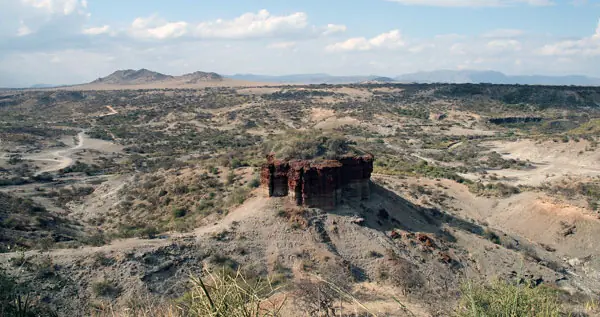
Olduvai Gorge is a 48 km ravine in the Ngorongoro Conservation Area, about 150 km northwest of Arusha. Its layered volcanic walls preserved fossils and stone tools dating back up to 1.89 million years. In 1959 Mary Leakey found Paranthropus boisei (the "Nutcracker" skull) here, and in 1960 the remains of Homo habilis were discovered - pushing the known age of the human lineage back by more than a million years. The site gave its name to the Oldowan culture, the world's earliest stone-working technology.
Safari Guide's Note
Olduvai Gorge is located at the road fork between Ngorongoro Crater and the central Serengeti. You can visit the museum as part of any Masatu Tours safari that covers both parks. Just let your guide know you want to stop, and you will walk in the footsteps of the Leakeys.
What Is Olduvai Gorge?
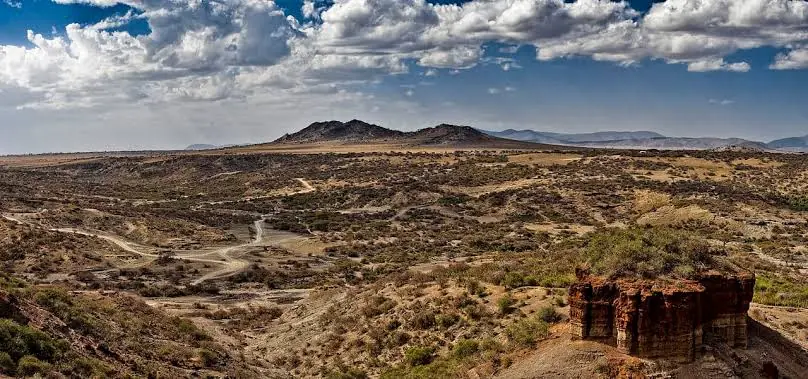
Olduvai Gorge lies 150 km (90 miles) northwest of Arusha, within the Ngorongoro Conservation Area. It sits on the eastern Serengeti Plains and stretches for roughly 48 km through a landscape of open grassland and acacia scrub. The gorge itself was carved over hundreds of thousands of years by seasonal rivers cutting through layers of volcanic deposits left by an ancient eruption.
Those volcanic layers are what make Olduvai so extraordinary. They preserved fossils, bones, and stone tools in a sequence of clearly defined geological strata, each layer representing a different period of time. Scientists can date these layers precisely using radiometric methods, which means the timeline of human evolution can be read almost like chapters in a book.
A Name in the Earth
The name "Olduvai" comes from the Maasai word Oldupai, which refers to a wild sisal plant (Agave sisalana) that grows abundantly in the area. The German scientist Wilhelm Kattwinkel first recorded the site in 1910 and inadvertently changed the spelling to "Oldway." The corrected name stuck.
The Story of Discovery
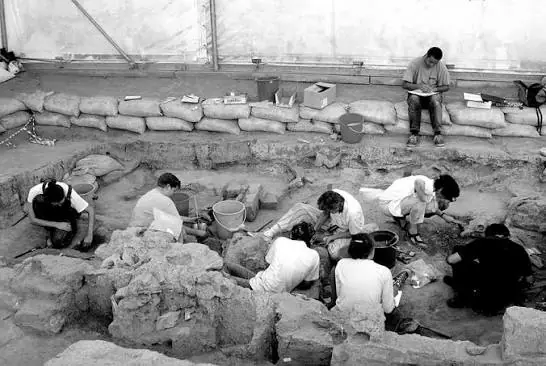
The story of Olduvai begins with a German scientist chasing a butterfly. In 1910, Wilhelm Kattwinkel, a doctor and anthropologist studying African Sleeping Sickness, ventured into the Ngorongoro Crater. While following a butterfly through the bush, he stumbled and fell from a precipice. When he regained consciousness, he found himself lying in a gorge filled with bones and ancient stone tools.
Among his first finds were the bones of a prehistoric three-toed horse. Kattwinkel recognized the significance of the site and named it "Oldway." Other German scientists, including Wilhelm von Branca and Hans Reck, rushed to the location. In 1913, Reck led an expedition that uncovered a skeleton he estimated to be around 150,000 years old. The skeleton was controversial; some argued it had been re-buried at a later date. Radiocarbon dating eventually confirmed the bones were roughly 17,000 years old, but the tools found alongside them were far older.
After World War I, the former German colony came under British rule, and Louis Leakey, a British anthropologist working in Kenya, set up a new expedition to Olduvai. He invited Hans Reck along, and the two made a wager for ten pounds that Leakey would find something on his very first day. It took Leakey six hours. He unearthed an ancient cleaver made of volcanic rock and went on to excavate 77 similar tools in the following days. He had won the bet and found evidence of a stone-working culture far older than anything previously known.
The Six-Hour Bet
Louis Leakey bet Hans Reck ten pounds that he would find a significant artifact on his very first day at Olduvai. It took him six hours to uncover an ancient volcanic-stone cleaver - the start of 77 similar tools found in the days that followed.
Despite this early success, personal scandals, career problems, and eventually World War II diverted attention from Olduvai for decades. It was not until the 1950s that Louis and Mary Leakey returned to continue their investigations in earnest.
The Leakey Breakthroughs
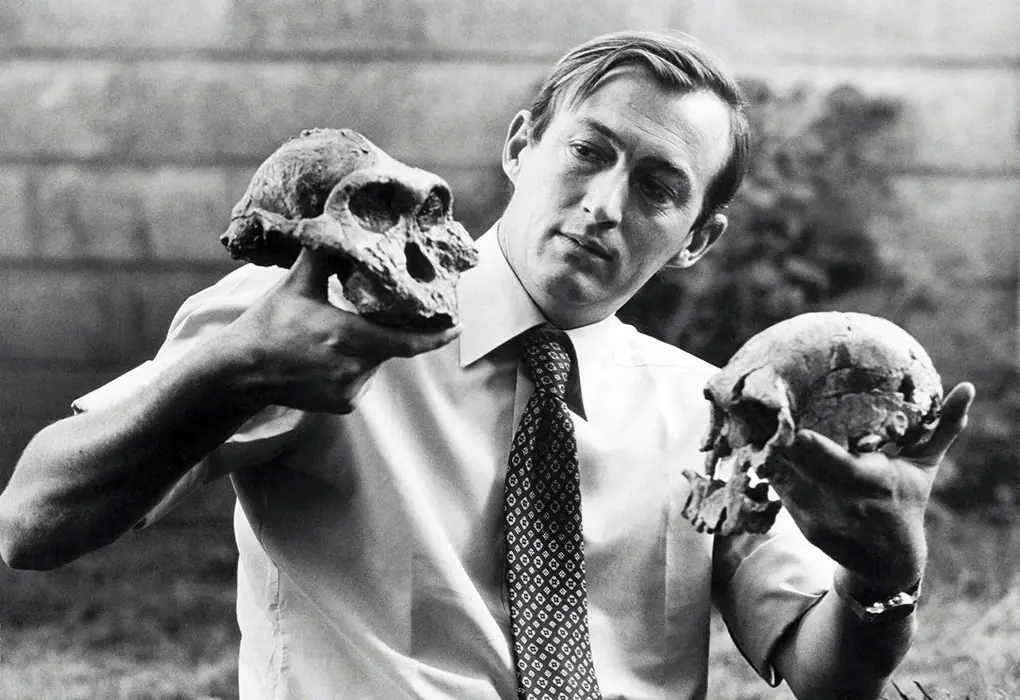
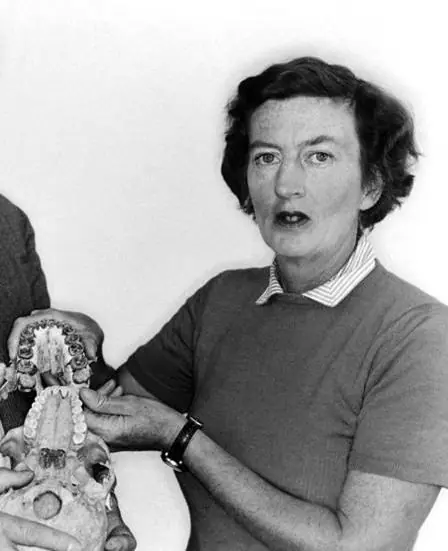
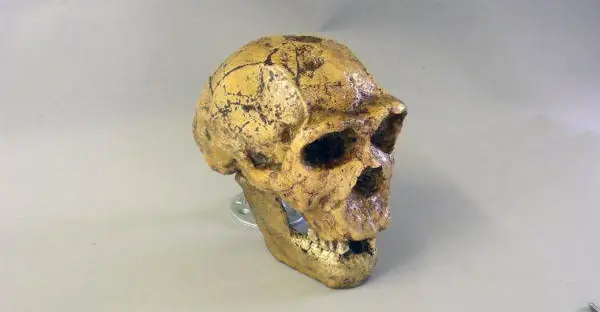
In July 1959, Mary Leakey was leading the excavations while Louis stayed in camp due to illness. That morning she found a fragment of an unusual bone: part of a jaw with two teeth. It did not belong to a modern human or to an ape. Over the following days, more fragments were collected and assembled into a nearly complete skull, nicknamed the "Nutcracker."
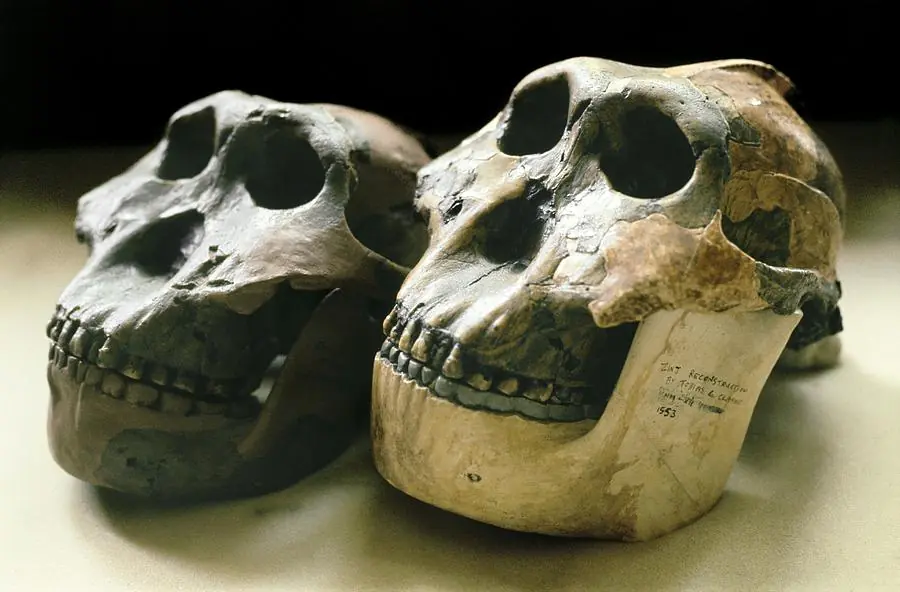
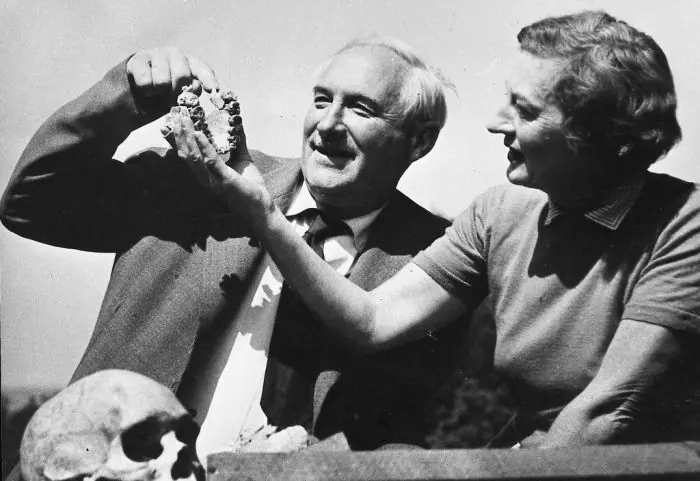
Louis Leakey proposed that this was a new species of Australopithecus, which he named Zinjanthropus. Later, more detailed analysis renamed the species Paranthropus boisei, and its age was determined to be about 1.75 million years. It was likely a member of a sister group to humans that eventually became extinct, though the debate continues.
A chipped pebble was found next to the Nutcracker, clearly a primitive stone tool. Louis Leakey argued that this species was the first animal in history to use tools. The next year, 1960, brought even more sensational discoveries.
The Cradle Lineage, One Gorge
Olduvai documented the critical transition from Australopithecus to the genus Homo. The stone tools found here show that the earliest humans developed tool-making as they adapted to life on the savannah, which freed their hands, expanded their brains, and enabled them to spread across the globe.
Mary Leakey became the expedition director as Louis's health no longer allowed him to lead fieldwork. Soon, several remains were found that sent shockwaves through the scientific community. Geophysicists dated the layers to between 1.89 million and 1.75 million years ago.
In 1960, parts of a skeleton of Homo erectus, the direct ancestor of modern humans, and fragments of Homo habilis were found. While erectus had been discovered before in Asia and Europe, the habilis found at Olduvai was the first of its kind. A total of two erectus and six habilis finds were made at the site. The stone tools belonged to Homo habilis, which anthropologists called "handy" for this reason.
Before Olduvai, the human race was thought to be only about 600,000 years old. The gorge showed that our lineage extends back by at least a million years more. Louis Leakey's bold hypothesis that humans originated in Africa was fully confirmed and became the dominant theory in the scientific community.
Paranthropus boisei
The "Nutcracker" skull, found in 1959, dated to 1.75 million years ago. A heavy-jawed species likely belonging to a sister group of the human lineage.
Homo habilis
The "handy man," first member of the genus Homo. Found at Olduvai in 1960, dated to 1.89-1.65 million years ago. Made the first stone tools.
Homo erectus
The "upright man," direct ancestor of Homo sapiens. Two finds at Olduvai. First human to leave Africa and settle across Eurasia.
Homo ergaster
The "working man," descended from habilis. Developed more advanced tools. Ancestor of erectus. First appeared in East Africa.
Oldowan Culture & the First Tools
The stone tools discovered by the Leakeys at Olduvai gave their name to the earliest known stone-working culture: Oldowan culture. Also called "pebble culture," it includes not only the tools found at Olduvai but similar finds across East Africa and beyond, including Kenya, Ethiopia, the Caucasus, Crimea, and Eastern Europe.
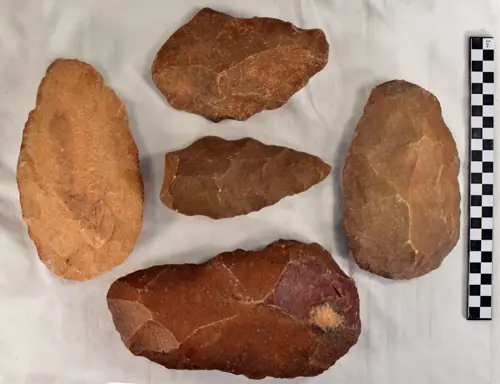
The simplest Oldowan tool is a stone broken in half, with a sharp edge for cutting meat. It was Homo habilis, the "handy human," that first learned to make these tools, separating itself from australopithecines and other primates. The ability to create tools is one of the features that most clearly distinguishes humans from other animals.
Experts classify these early tools into several categories by shape and purpose. The most famous is the chopper, a predecessor of the hand axe: a small stone with one edge sharpened by splintering, the other side left smooth for gripping. Small shards produced during chopper-making served as proto-knives, the first cutting implements in human history.
Oldowan's Long Afterlife
Oldowan culture eventually disappeared about 1 million years ago, replaced by the more refined Abbeville and Acheulean cultures, which introduced finer hand-held axes for working carcasses, digging up plants, and cutting branches. However, the simpler choppers remained in use for a remarkably long time. In the 19th century, natives of Tasmania were still using tools of the same basic design.
What the Stone Tools Tell Us
Figuring out the types of the first tools is not as interesting as trying to understand what they mean. Why did anthropologists get so excited when they found artificially produced stone fragments in the gorge? Why did geologists spend years analyzing everything under their feet, dozens of meters deep? For example, American geologist Richard Hay devoted 12 years to field research in Olduvai alone.
The answer lies in what these discoveries reveal about how we became human. Bone fragments from ancient primates answer how humans separated from other animals. Unnaturally chipped rocks answer why this occurred.
Human ancestors were forced down from trees to the ground because of global changes in vegetation. Habitats became more arid, savannahs expanded where dense forests once stood. The transition from climbing with four limbs to walking upright on two freed the hands for more complex interaction with the environment. This drove changes in both the hands and the brain, which underwent a major expansion.
Alongside this, jaws and teeth changed. The jaw shortened, canines and premolars decreased in size. To distinguish hominids from all other primates, only two criteria are used: bipedalism and reduction of the maxillary apparatus. The increased brain volume is an additional marker, though it varies among ancestors.
Life on the savannah forced these transformations. Open spaces brought danger from large predators and competitors like giant geladas, massive ancient baboons that inhabited the area between 3 and 2.5 million years ago. As forests shrank and plant food decreased, human ancestors switched to partial predation, scavenging animal carcasses. Stones were needed to carve them up.
The further sequence of events split into two lines. One traced the evolution of tool-making from simple choppers to sophisticated hunting devices, turning scavengers into hunter-gatherers. The other traced physiological adaptation: lighter bodies from reduced plant food, but stronger frames and better endurance from increased meat consumption. Homo erectus, the "upright man," was the first to leave Africa and settle across Eurasia, carrying its inherited technology to every region it reached.
The Leakey Legacy
Louis Leakey did not stop at archaeology. Recognizing that behavior was the key to understanding differences between humans and apes, he launched the "Leakey Angels" project: Jane Goodall studying chimpanzees in Tanzania, Diane Fossey observing gorillas in Rwanda, and Birute Galdikas working with orangutans in Borneo. You can visit Gombe Stream National Park in Tanzania to observe chimpanzees today.
The Olduvai Gorge Museum
Much of what was found in Olduvai Gorge can be seen at the museum on the edge of the gorge itself, within the Ngorongoro Conservation Area. Mary Leakey opened it in the 1970s. In 2018, it was completely rebuilt and expanded with new exhibits and artifacts from other African excavation sites. The displays combine modern design with interactive scenes from the lives of the first humans.
The museum complex itself is built in the style of a traditional Maasai boma, a circular village with semi-circular dwellings. It is a reference to the architecture of the tribal people who have inhabited this land for centuries.
The Laetoli Footprints
A separate hall displays fossilized footprints discovered by Mary Leakey at nearby Laetoli. These footprints are 3.6 to 3.8 million years old, the oldest evidence of bipedalism found to date. They appear to show a family walking across volcanic ash: a male, followed by a female holding a baby by the hand.
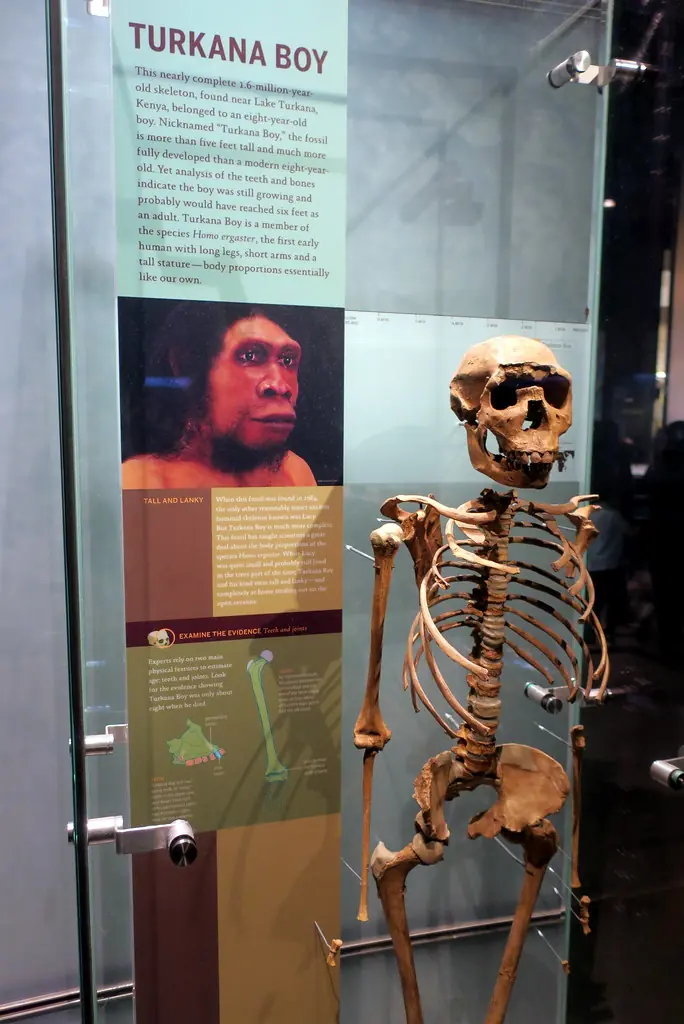
Inside, you can see the Nutcracker, the skull of Paranthropus boisei found by Mary Leakey in 1959, along with fragments of Homo habilis and Homo erectus skeletons from Olduvai. Copies of the world's most famous skeletons are displayed as well: Australopithecus Lucy, the 3.2 million-year-old skeleton preserved by a lake, and the Turkana Boy, a representative of Homo ergaster who lived 1.53 million years ago.
The museum also displays bones of ancient animals: elephants, giraffes, hippos, and several now-extinct species. Among the most striking exhibits are the tusks of an ancient boar that reached the size of a modern elephant. And of course, the collection includes many Oldowan stone tools: choppers, spheroids, scrapers, and other implements that helped our ancestors gain a huge advantage over other animals.
Can We Expect New Discoveries?
Is it possible that archaeological sensations from Olduvai ended in the 20th century? Why has nothing significant been found recently in such a uniquely well-preserved area? Have the excavations stopped?
In fact, Olduvai and many similar locations across East Africa await further archaeological work. Tanzania is slower to develop than other regions, and the country's own scientific capabilities do not yet allow research at the scale that paleoanthropologists worldwide would like to see. Research continues, but neither its intensity nor its quality matches international standards. Most findings today are the result of chance.
The 2009 Find
In 2009, skull fragments were found that could potentially belong to the oldest Homo sapiens ever discovered. A scientific description published in 2018 confirmed that these fossilized remains do belong to our species. Dating remains difficult, and no concrete age has been established yet, but the implications are enormous.
There is an unproclaimed race among African countries to find the oldest sapiens fossil. Olduvai Gorge, which already delivered the first representative of the human species to the world, may yet produce the next great archaeological sensation. The excavations continue. We must be patient.
How to Visit Olduvai Gorge
Reading about the origins of the human race is not enough to fully grasp the enormity of what Olduvai has preserved. Visiting in person is a different experience entirely. The museum is located at the road fork between Ngorongoro Crater and the Serengeti, so you can combine a visit with any safari that covers both parks.
Location
Approximately 150 km northwest of Arusha, within the Ngorongoro Conservation Area. The museum sits at the junction of the road to Ngorongoro Crater and the road into the Serengeti.
Best Combined With
A 7-day or longer safari visiting Ngorongoro Crater and the Serengeti is the ideal way to include Olduvai. The museum visit is brief, 30 to 60 minutes, and fits naturally into a game-drive day.
What You Will See
Fossils, stone tools, interactive displays, and a stunning view of the gorge itself. The 2018 renovation added modern exhibits and digital displays that bring the ancient world to life.
Nearby Attractions
The Laetoli footprints site is not far away, and Maasai village visits can be arranged as part of your Ngorongoro and Serengeti itinerary. You can compare the ancient fossils with the contemporary wildlife of this landscape.
The panoramic view from the museum terrace stretches across the eastern Serengeti Plains, the same landscape the earliest humans walked. Consider arriving in the mid-morning, when the light reveals the color of the volcanic layers best.
Frequently Asked Questions
Olduvai Gorge is a 48 km long ravine in the Ngorongoro Conservation Area of northern Tanzania. It is one of the most important paleoanthropological sites in the world because it preserved fossils and stone tools dating back up to 1.89 million years, providing critical evidence for human evolution in East Africa.
Olduvai Gorge lies approximately 150 km (90 miles) northwest of Arusha, within the Ngorongoro Conservation Area in northern Tanzania. It sits on the eastern Serengeti Plains and is easily visited en route between Ngorongoro Crater and the central Serengeti.
Mary Leakey found the skull of Paranthropus boisei (the Nutcracker) in 1959, dated to 1.75 million years ago. In 1960, remains of Homo habilis and Homo erectus were discovered, confirming the site as the cradle of humankind and pushing the known age of the human lineage back by over a million years.
Finds at Olduvai range from approximately 1.89 million years old to about 15,000 years old. The most significant discoveries, including Homo habilis and Paranthropus boisei, are between 1.75 and 1.89 million years old.
Oldowan culture, also known as pebble culture, is the earliest known stone-working technology. It began at least 2.6 million years ago and includes simple choppers and flakes used for cutting meat and processing plant material. It is named after Olduvai Gorge where the tools were first identified.
Yes. The Olduvai Gorge Museum, rebuilt and expanded in 2018, is open to visitors within the Ngorongoro Conservation Area. It displays fossils, stone tools, and interactive exhibits about human evolution. The museum is located at the road fork between Ngorongoro Crater and the Serengeti.
In 2009, skull fragments were found that may belong to the oldest Homo sapiens ever discovered. A scientific description published in 2018 confirmed the fossils belong to our species, though precise dating is still underway. Excavations continue at the site.
Olduvai Gorge records the critical transition from Australopithecus to the genus Homo. The stone tools found here show that the earliest humans developed tool-making as they adapted to life on the savannah, which freed their hands, expanded their brains, and enabled them to spread across the globe.
Fossil evidence shows that elephants, giraffes, hippos, and various primates once lived in the area. The museum displays tusks of an ancient boar that reached the size of a modern elephant, along with bones of several now-extinct species.
Olduvai Gorge is part of the Ngorongoro Conservation Area, which is a UNESCO World Heritage Site. The gorge itself is recognized as one of the most significant paleontological sites on the planet and a key location in understanding human origins.
Plan Your Olduvai Gorge Visit
Walk in the footsteps of the Leakeys. Add Olduvai Gorge to your Ngorongoro and Serengeti safari itinerary with Masatu Tours. Our expert guides will show you the gorge, the museum, and the landscape where human history began - a 48 km library written in volcanic ash, containing the most important story ever told.
Visiting Olduvai is a chance to stand at the place where our story began. The museum, the gorge, and the surrounding savannah offer something that no book or documentary can fully capture: a sense of time, of scale, of what it means to be part of a lineage that stretches back millions of years.
More History & Culture Guides
GuidesNgorongoro Crater Guide
Explore the world's largest volcanic caldera
Where Is Mount Kilimanjaro?
Geography and location of Africa's highest peak
Serengeti National Park Guide
The world's most famous wildlife ecosystem
Experiencing Maasai Culture
Traditions of Tanzania's most famous tribe
The Shortest War in History
38 minutes of fighting in Stone Town, Zanzibar, 1896
Tanzania Safari Packages
Plan your Ngorongoro and Serengeti safari
Last updated: September 16, 2026. All facts verified against current paleoanthropological research and museum data.
