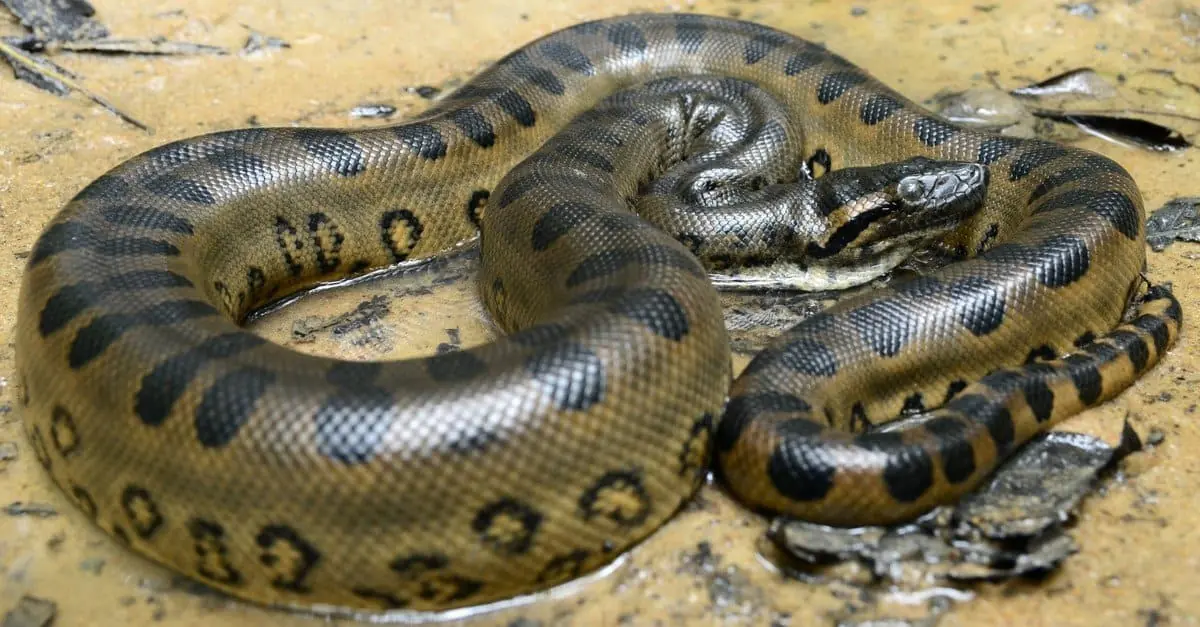
King Cobra
Ophiophagus hannah
Length
3-4 m (10-13 ft)
Weight
6-12 kg (13-26 lbs)
Record
5.71 m (19 ft)
Record Weight
12 kg (26 lbs)
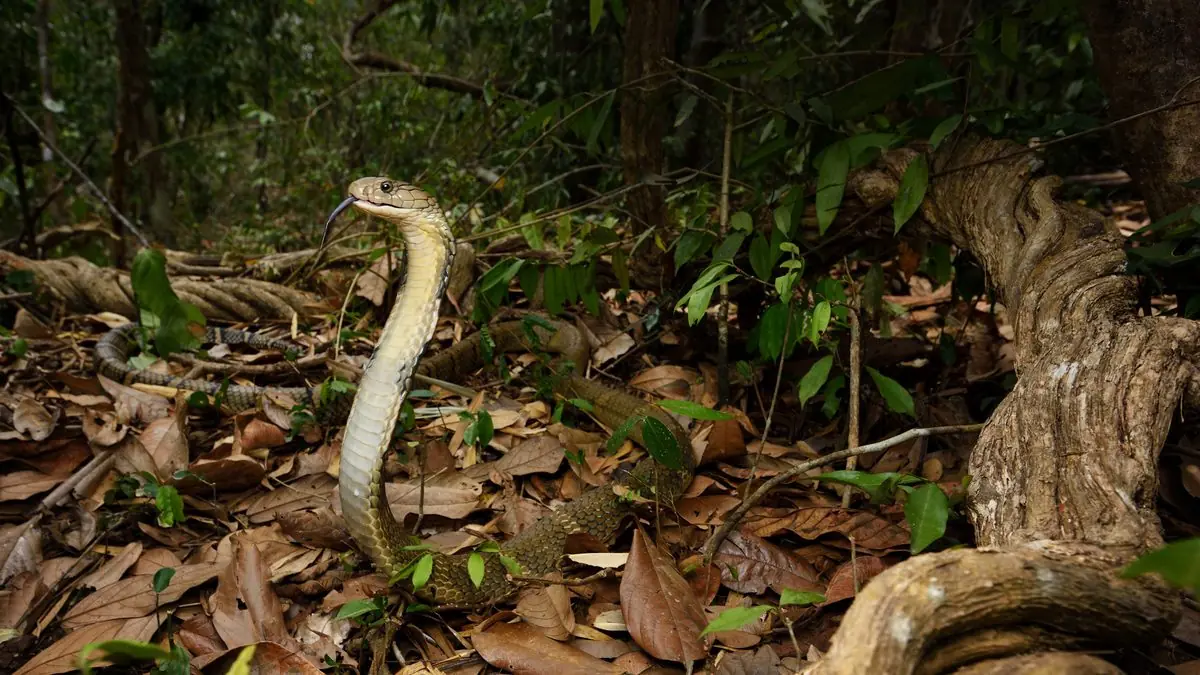
The king cobra is the longest venomous snake in the world, easily recognized by its pale crossbands. Its bite delivers 400-700 milligrams of powerful neurotoxic venom, capable of paralyzing respiratory muscles. This dose is enough to kill an elephant, or 20 to 30 people, within hours.
Unlike most large snakes, the king cobra does not lie in ambush. It actively hunts its prey, which consists mainly of other snakes — a rare trait reflected in its scientific name, Ophiophagus, meaning snake eater. It will occasionally feed on lizards or rodents.
Key Facts
- • The king cobra lifts the front third of its body up to 2 m (6.5 ft) high and spreads its neck ribs into a dramatic hood when threatened, emitting a deep, growl-like hiss.
- • It is the only snake known to build a nest for its eggs. The female piles leaves and branches into a mound up to 1 m (3.3 ft) high, lays 20-40 eggs inside, and guards them.
- • A giant king cobra captured in Malaysia in 1937 grew to 5.7 m (19 ft) at the London Zoo by 1939, earning a Guinness World Record.
Common Boa
Boa constrictor
Length
2.5-3 m (8-10 ft)
Weight
15-25 kg (33-55 lbs)
Record
4.2 m (14 ft)
Record Weight
25 kg (55 lbs)
One of the most recognizable snakes in the world, the common boa is easily identified by the large spots along its back, which darken to reddish or burgundy toward the tail.
This species thrives in a wide range of habitats, from tropical forests to dry savannas. Its evolutionary success is not due to size or strength, but to adaptability and effective reproductive strategy. Unlike pythons, which lay eggs, the boa is ovoviviparous: the female carries eggs internally, giving birth to 25-35 young after 5-8 months.
Key Facts
- • The common boa is often called the perfect all-rounder because of its wide range and varied diet, feeding on small mammals, birds, and lizards.
- • It is ovoviviparous, meaning females give birth to live young rather than laying eggs, providing better protection for offspring.
Cuban Boa
Chilabothrus angulifer
Length
2.5-4 m (8-13 ft)
Weight
15-30 kg (33-66 lbs)
Record
4+ m (13+ ft)
Record Weight
30 kg (66 lbs)
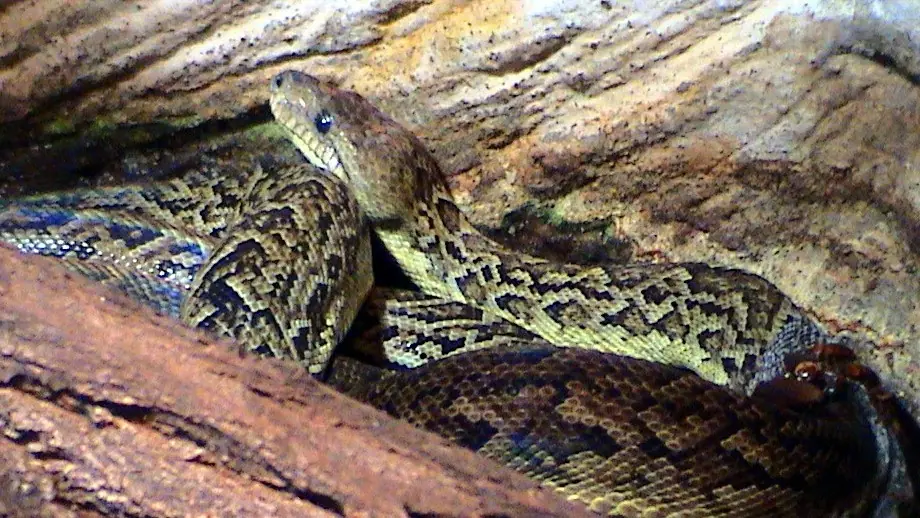
The Cuban boa is the largest snake species in the Caribbean and the top terrestrial predator in Cuba.
One of its most remarkable traits is its ability to hunt bats in caves. The snake ambushes prey at cave entrances or from the ceilings, snatching bats in mid-flight — sometimes hunting cooperatively. Its diet also includes birds, rodents, and lizards.
Key Facts
- • Its Latin name, angulifer, means angular, a reference to the distinctive pattern on its back.
- • Partially arboreal, the Cuban boa moves with confidence through branches, aided by its powerful muscles and the structure of its belly scales.
Yellow Anaconda
Eunectes notaeus
Length
3-4 m (10-13 ft)
Weight
15-30 kg (33-66 lbs)
Record
4.6 m (15 ft)
Record Weight
40 kg (88 lbs)
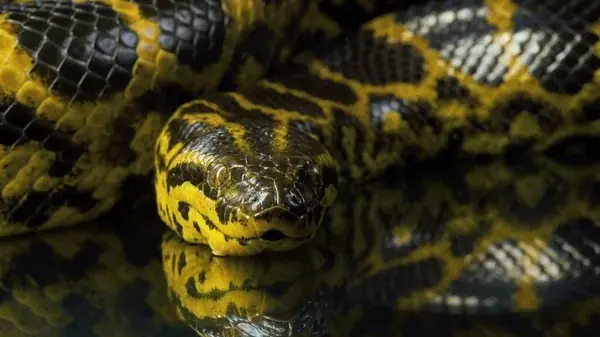
Although smaller than the green anaconda, this species is incredibly strong. Its golden-yellow and olive coloration, marked with dark spots, provides excellent camouflage in murky waters.
The yellow anaconda inhabits slow-flowing rivers, swamps, and marshy lowlands. It hunts from ambush in shallow water, striking prey that swims by or comes to drink, including fish, waterfowl, lizards, and small mammals.
Key Facts
- • Like other anacondas, the yellow anaconda is ovoviviparous: the female carries her young for about six months. A typical litter includes 20-40 offspring, each measuring roughly 50-60 cm (20-24 in) at birth.
- • There are recorded instances of it attacking larger animals, such as caimans and capybaras.
Indian Python
Python molurus
Length
3-4 m (10-13 ft)
Weight
20-40 kg (44-88 lbs)
Record
4.6 m (15 ft)
Record Weight
52 kg (115 lbs)
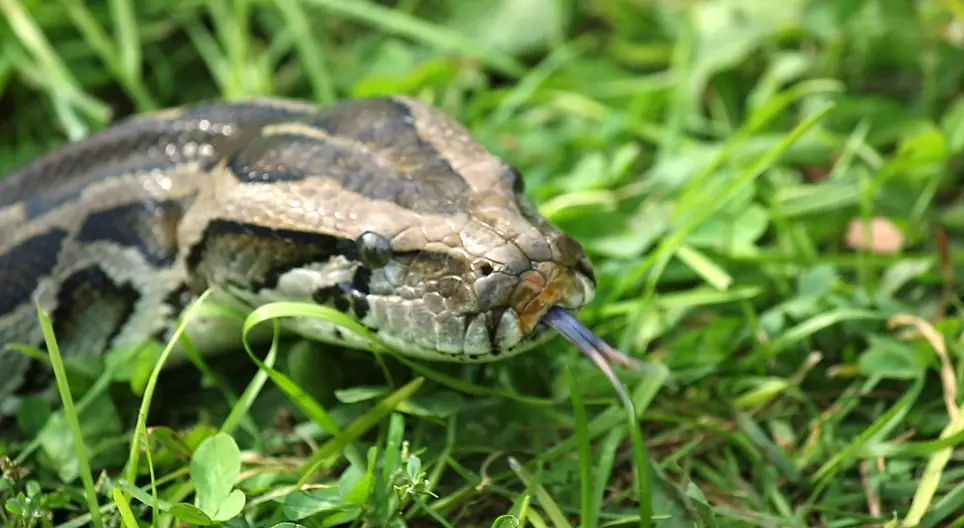
The Indian python has pale yellow-brown coloring with large spots along its back. It is most often found near water and can remain submerged for up to 30 minutes.
This species has heat pits on its snout: organs sensitive to infrared radiation emitted by warm-blooded animals. These allow the python to detect prey even in complete darkness, making it a highly effective nocturnal hunter.
Key Facts
- • The Indian python is believed to have inspired Kaa, the wise python in Rudyard Kipling's The Jungle Book, set in central India, its natural habitat.
- • Its diet includes rats, hares, mongooses, monkeys, domestic birds, peafowl, partridges, and reptiles.
Amethystine Python
Simalia amethistina
Length
4-5 m (13-16 ft)
Weight
15-25 kg (33-55 lbs)
Record
5.65 m (19 ft)
Record Weight
24.5 kg (54 lbs)
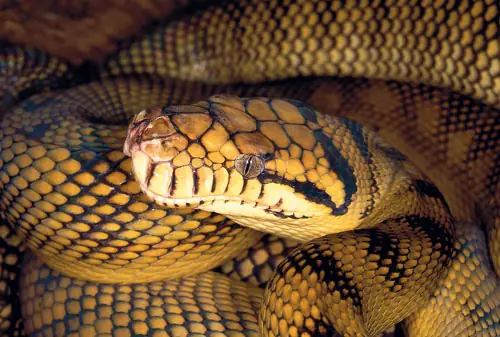
In sunlight, the scales of the amethystine python shimmer with a violet-blue sheen, giving the species its name. This iridescent effect is caused by the scales' special structure, which refracts light.
One of the largest arboreal snakes, adults often climb branches, using their strong muscles and tail for support. It usually hunts at dusk, feeding on birds, mammals, and small lizards.
Key Facts
- • Young snakes are shy and highly defensive, but as they mature, they generally become calmer while remaining alert.
- • Also known as the Australian scrub python, it is one of the largest non-venomous snakes in Australia.
African Rock Python
Python sebae
Length
3-5 m (10-16 ft)
Weight
40-45 kg (88-99 lbs)
Record
5.8-6 m (19-20 ft)
Record Weight
50+ kg (110+ lbs)
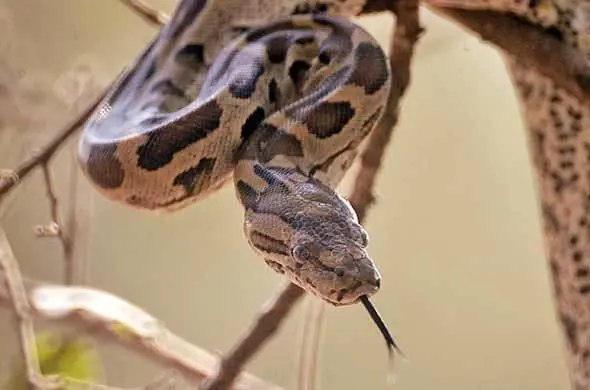
The African rock python is the largest snake in Africa. It is most commonly found near rocky outcrops or water sources, where it can ambush prey. Its size and strength are impressive enough to take down small antelopes, warthogs, monkeys, young crocodiles, and even livestock.
Primarily terrestrial, this snake can also climb trees and swim, remaining underwater for extended periods. During the dry season, it often shelters in burrows or rock crevices and may enter dormancy.
Key Facts
- • The female exhibits strong parental care, coiling around her clutch to protect it from predators and using rhythmic muscle contractions to raise her body temperature and warm the eggs.
- • The rock python earned a reputation as a dangerous predator after a 1980 incident in South Africa, when it attacked a 13-year-old shepherd. In reality, encounters with humans are extremely rare.
Burmese Python
Python bivittatus
Length
3-5 m (10-16 ft)
Weight
40-70 kg (88-154 lbs)
Record
5.74 m (19 ft)
Record Weight
70 kg (154 lbs)
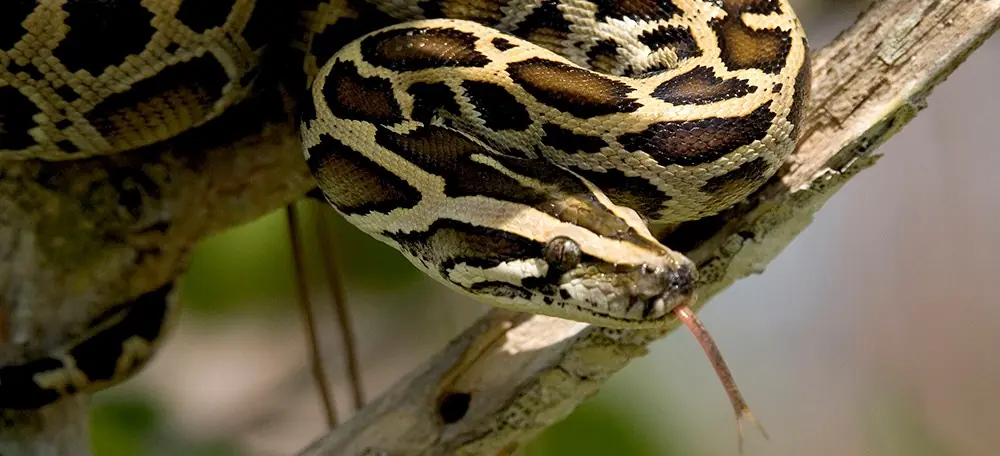
Burmese pythons are generally calm and sluggish. In their first months, they remain in the treetops, hunting small mammals and birds. As they grow and gain weight, they shift to a terrestrial lifestyle, preying on larger animals such as raccoons, opossums, and rabbits.
Thanks to flexible joints in their skulls, these pythons can swallow prey roughly equal to their own mass. There are recorded cases of them hunting small deer.
Key Facts
- • The largest recorded Burmese python, nicknamed Baby, lived to 27 years and measured 5.74 meters (19 feet), as confirmed by Guinness World Records.
- • Between 2003 and 2011 in Florida, scientists recorded a 99.3% decline in raccoon populations and a 98.9% drop in opossums in areas where Burmese pythons were introduced. Over 23,000 individuals have been captured since 2012.
Reticulated Python
Malayopython reticulatus
Length
4-6 m (13-20 ft)
Weight
30-60 kg (66-132 lbs)
Record
7.67 m (25 ft)
Record Weight
158.8 kg (350 lbs)
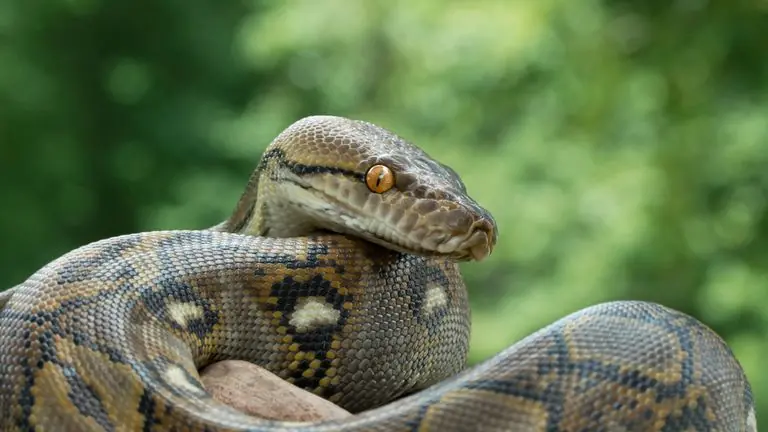
Reticulated pythons are easily recognized by their intricate mosaic pattern of yellow, brown, and black diamonds, forming a net that provides excellent camouflage among leaves and shadows.
These snakes are nocturnal hunters. Thanks to the flexible connection between their upper and lower jaws, they can open their mouths up to 160 degrees and swallow prey thicker than their own bodies, from birds and monkeys to small pigs and deer.
Key Facts
- • One of the largest scientifically documented specimens was captured in 1912 on the island of Sumatra, measuring 6.95 meters (23 feet).
- • In 2011, a reticulated python named Medusa grew to 7.67 m (25 ft) and weighed 158 kg (350 lbs) in a U.S. zoo, earning a Guinness World Record.
- • While they eat, their skin and muscles stretch and their internal organs shift without interrupting blood flow. Digestion can last up to two weeks.
Green Anaconda
Eunectes murinus
Length
4-5 m (13-16 ft)
Weight
Up to 70 kg (154 lbs)
Record
5.21 m (17 ft)
Record Weight
97.5 kg (215 lbs)
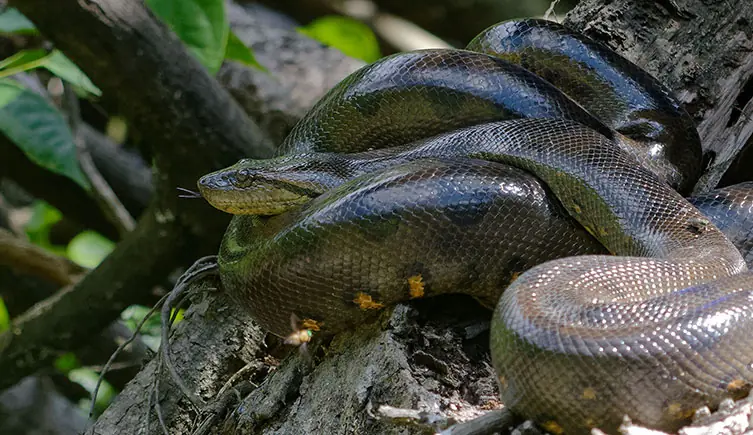
The green anaconda is the heaviest snake in the world and a living relic of its family, having changed very little over millions of years. Its olive-green coloration, marked with large dark spots, provides near-perfect camouflage in murky water.
Anacondas hunt in swamps and slow-moving rivers, moving at 8-10 km/h (5-6 mph). They do not chase prey but ambush it, coiling around victims and constricting until breathing stops. Their diet includes capybaras, caimans, waterfowl, and fish.
Key Facts
- • The longest recorded green anaconda measured 5.21 m (17 ft) and weighed 97.5 kg (215 lbs), documented by Dr. Antonio Rivas during research in Venezuela in the 1990s.
- • While some sources suggest lengths of 6.3-6.4 m (21 ft), these are theoretical maximums, and reports of snakes 7-10 m (23-33 ft) long remain unverified.
3 Largest Extinct Snakes
Fossil records reveal that ancient snakes grew far larger than any living species. These three extinct giants dwarf even the biggest anacondas and pythons alive today.
Vasuki
Vasuki indicus
Length
~11-15 m (36-49 ft)
Weight
~1 ton (2,200 lbs)
Period
~47 million years ago
One of the biggest snakes that ever lived, Vasuki was closely related to modern anacondas. Its broad, laterally compressed vertebrae suggest a thick, powerful body. The remains, a series of 27 vertebrae from an adult, were described in detail in April 2024 by Indian paleontologists. The genus was named after the mythical serpent Vasuki from Hindu tradition. Vasuki lived during a period of unusually warm climate that scientists believe contributed to its enormous size.
Palaeophis colossaeus
Palaeophis colossaeus
Length
~9 m (30 ft)
Weight
Several hundred kg (rough estimate)
Period
~55 million years ago
Palaeophis belonged to an ancient group of marine snakes adapted to a semi-aquatic lifestyle. Its body was laterally flattened, aiding movement underwater. Fossilized vertebrae discovered in the 1930s in Niger helped researchers identify the largest member of the genus. It lived during the early Eocene, when the region of today's Sahara was a warm marine basin, and likely fed on fish and other marine animals.
Titanoboa
Titanoboa cerrejonensis
Length
~12.8-14.3 m (42-47 ft)
Weight
Over 1 ton (2,200 lbs)
Period
~58-60 million years ago
Titanoboa is the largest known snake that ever lived. It likely looked similar to a modern anaconda but was much longer and heavier, with a body over a meter (3.3 ft) thick. Dozens of massive vertebrae and ribs, belonging to at least 28 individuals, were discovered in the early 2000s in a coal mine in northeastern Colombia. Based on its vertebrae and teeth, scientists believe Titanoboa was a semi-aquatic predator that hunted tropical catfish and giant ancient fishes from the Osteoglossidae family.
Expert Insight
Sara Ruane, Ph.D.
Curator of Herpetology, Field Museum of Natural History, Chicago
Among snakes living today, it is clear that green anacondas and reticulated pythons are the largest with respect to length, with anacondas being the heaviest in weight. Records of up to or around 30 feet are reasonable, while those much over 30 feet are more questionable. Any snake over 20 feet is seriously huge for either species.
Snakes try their absolute best to avoid contact with humans, and no snake is aggressive. Rather, snakes are defensive, meaning they are more likely to feel threatened and react. There are, however, some snakes large enough to think of humans as prey. This is not common overall, but there are verified records of reticulated pythons killing and consuming humans. The best way to stay safe is to give snakes a wide berth and observe them from a safe distance.
Frequently Asked Questions
Conclusion
The world's largest snakes are awe-inspiring creatures that have shaped ecosystems for millions of years. From the king cobra's venomous precision to the green anaconda's brute strength, each species on this list has evolved remarkable adaptations for survival.
Understanding these animals, their sizes, habitats, and behaviors helps us appreciate the biodiversity of our planet and the importance of conservation efforts. Whether you encounter a 3-meter king cobra in the forests of Southeast Asia or spot an anaconda in the wetlands of South America, these encounters remind us of the incredible diversity of life on Earth.
If you are planning a wildlife safari to see reptiles in their natural habitat, the experienced guides at Masatu Tours can help you find the best locations and ensure safe, respectful wildlife viewing.
