Key Facts
Bush babies (galagos) are small nocturnal primates of sub-Saharan Africa. They belong to the suborder Strepsirrhini (wet-nosed primates), making them relatives of lemurs and lorises. Over 20 species exist, from the tiny Prince Demidoff's bush baby to the larger greater galago. Their enormous eyes, rotating ears, and powerful hind legs make them exceptional nocturnal hunters.
What Is a Bush Baby (Galago)?
If you stay in the African countryside away from cities and take a stroll late at night, you will often hear noises resembling intermittent baby cries coming from the nearby bushes and trees. Those unfamiliar with local wildlife might guess it is monkeys, but these are bush babies, also known as galagos, small nocturnal primates that live in tree hollows across sub-Saharan Africa.
These captivating creatures are among the most successful primates in Africa. Galagos are the most successful of all lower primates due to their diversity, abundance, and vast range. Yet despite their numbers, most people never see one; they are masters of stealth, hidden by day and active only after dark.
The bush baby, or galago, is a small nocturnal primate belonging to the familyGalagidae within the suborder Strepsirrhini, the wet-nosed primates. A wet nose helps animals detect wind direction and break down complex odours. Cats and dogs have wet noses for the same reason; humans, as dry-nosed primates (Haplorhini), do not.
Bush babies share their suborder with lemurs (found only in Madagascar and Comoros) and lorises, pottos, and angwantibos (found in tropical Africa and Asia). However, galagos are distinct enough to form their own family within the superfamily Lorisoidea.
Bush Baby vs Lemur: Key Differences
| Feature | Bush Baby (Galago) | Lemur |
|---|---|---|
| Range | Sub-Saharan Africa | Madagascar & Comoros only |
| Activity | Strictly nocturnal | Diurnal, crepuscular, or nocturnal |
| Tail | Long, bushy, used as counterbalance | Variable, some species have prehensile tails |
| Ears | Large, independently rotating, bat-like | Smaller, less mobile |
| Jumping ability | Up to 5m (100x body length) | Moderate, most cannot leap far |
| Number of species | 20+ species (family Galagidae) | 100+ species (family Lemuridae & others) |
Key characteristics of wet-nosed primates include:
- Moist, rhinarium-like nose pad for enhanced smell
- Thumb does not fully oppose other fingers
- Elongated "grooming" claws on the second toe for hair care
- Poor colour vision, an adaptation to nocturnal life
- Smaller brain volume compared to monkeys and apes
The name "bush baby" comes from their distinctive call, which resembles the sound of a crying human infant. In Afrikaans they are called nagapie, meaning "night monkey". Their scientific name, Galago, is thought to derive from a local West African name.
Did you know? Bush babies can leap up to 5 metres between branches, a distance 100 times their body length. Their leg muscles are 6–9 times more powerful than a frog's.
Species of Galagos
Over 20 species of galagos have been formally described, and scientists anticipate more will be discovered. They vary enormously in size, appearance, habitat, and behaviour, sometimes so much that different species look like completely unrelated animals.
| Species | Range |
|---|---|
| Brown Greater Galago | East & Southern Africa |
| Northern Greater Galago | East Africa |
| Senegal Bush Baby | West, Central & East Africa |
| Prince Demidoff's Bush Baby | Central Africa |
| Uluguru Bush Baby | Tanzania & Kenya (highlands) |
| Zanzibar Bush Baby | Zanzibar & mainland Tanzania |
| Somali Lesser Galago | Horn of Africa |
Biologists sometimes find it easier to distinguish galago species by their calls rather than appearance. Each species has a unique repertoire of cries, squeals, and squeaks used for communication, territorial defence, and alerting others to danger.
Appearance & Adaptations
 Tap to enlarge


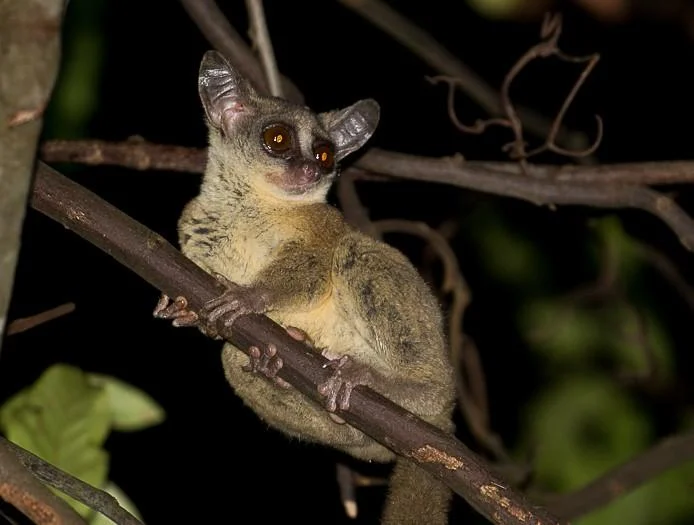
Every feature of a bush baby's body is perfectly adapted for nocturnal arboreal life. Their enormous eyes are their most striking characteristic, they capture maximum available light, giving galagos excellent night vision. This is essential for hunting insects and navigating the forest canopy in near-total darkness.
Their ears are equally remarkable. Large, delicate, and capable of rotating independently like radar dishes, they allow bush babies to pinpoint the exact location of prey, even insects moving underground. During the day, while sleeping, galagos fold their ears flat against their body to block out sound. They do the same while jumping through branches to prevent injury.
Bush babies have powerful hind legs that give them extraordinary jumping ability. They can cover up to 5 metres in a single bound, more than 100 times their body length for smaller species. Their long, flexible tail acts as a counterbalance, allowing them to change direction mid-air and land precisely on a chosen branch.
Their hands and feet are equipped with strong grasping fingers with fleshy pads that help them grip smooth bark. The second toe bears an elongated "grooming claw" used for cleaning fur, a characteristic shared with other wet-nosed primates.
Behavior & Social Life
Bush babies are nocturnal. They emerge from their tree hollows or leaf nests at dusk and remain active until dawn. During the day they sleep, often in groups, in nests made from leaves and twigs, in tree hollows, or occasionally in abandoned bird nests or beehives.
Social behaviour varies by species. Some galagos are predominantly solitary, with each individual defending its own territory. Others form small family groups. Females typically live with their offspring, while male offspring leave upon reaching maturity. In some species, males form bachelor communities.
One of the most unusual behaviours of bush babies is urine washing. They urinate on their hands and feet, then rub them together as they move through the branches. This leaves a scent trail that:
- Marks their territory and warns other galagos away
- Helps them retrace their own paths through the forest
- Communicates reproductive status and identity
As the renowned zoologist Bernhard Grzimek noted, this habit also produces a strong, persistent odour that makes bush babies entirely unsuitable as house pets.
Bush babies communicate through a complex system of vocalisations. Each species has its own repertoire ranging from soft squeaks to loud, baby-like cries. They call to mark territory, maintain contact with family members, warn of predators, and attract mates.
Diet & Hunting
Bush babies are omnivores with a varied diet that changes by species and season. Their typical diet includes:
- Tree gum, a major food source for many species, scraped from branches with specialised lower teeth
- Fruit, especially soft, ripe fruits found in the canopy
- Insects, beetles, moths, grasshoppers, and caterpillars caught in mid-air or plucked from bark
- Small vertebrates, frogs, lizards, small rodents, and occasionally small birds and eggs
- Flowers, seeds, and leaves, supplementary plant matter
Their large, bat-like ears allow them to hear insects moving inside tree bark or under leaves. Once located, bush babies snatch their prey with lightning-fast hand movements or pounce from above. Some species have been observed catching flying insects mid-air during their impressive leaps.
Tree gum is particularly important for several species, including the Senegal bush baby. They have specialised tooth combs (lower incisors angled forward) that scrape gum from tree trunks, and a wide, mobile tongue that laps it up. Gum is a reliable year-round food source when fruits and insects are scarce.
Natural Enemies
Despite their agility and nocturnal habits, bush babies face a range of natural predators:
Ground Predators
- • Mongooses
- • Genets
- • Jackals
- • Domestic dogs and cats
Aerial Predators
- • Owls, especially large species like the Verreaux's eagle-owl
- • Snakes, including pythons that raid nests
- • Large raptors active at dawn and dusk
Chimpanzee Predation
Perhaps the most remarkable predator of bush babies is the chimpanzee. In Senegal and other parts of Africa, chimpanzees have been documented making sharp sticks, primitive spears or clubs, that they thrust into tree hollows where bush babies sleep during the day. This behaviour, first observed by Jane Goodall in the 1960s and later confirmed by multiple researchers, shows that chimpanzees use tool-making for hunting mammals, not just for extracting termites. The sticks can be up to 60 centimetres long and are sharpened with the chimpanzee's teeth.
Habitat & Geographic Range
Bush babies are found across sub-Saharan Africa, from Senegal in the west to Somalia in the east, and south to South Africa. They are absent from the Sahara Desert and from Madagascar (where their lemur relatives dominate). Their range includes:
- Tropical rainforests, the richest habitat, supporting the greatest diversity of species
- Savannah woodlands, where they adapt to drier conditions
- Coastal forests, including Zanzibar and other near-shore islands
- Montane forests, the Uluguru bush baby lives at elevations up to 2,000 metres
- Urban gardens and hotel grounds, where they have adapted to human presence
The Zanzibar bush baby (Galago zanzibaricus) is found both on the island of Zanzibar and in coastal mainland Tanzania. The Uluguru bush baby is restricted to the Eastern Arc Mountains of Tanzania and Kenya, making it one of the more range-limited species.
On Mount Kilimanjaro, bush babies inhabit the forest zone between 800 and 2,000 metres. They are regularly seen (or more often heard) at campsites on the lower forest sections of the Lemosho, Machame, and Rongai routes.
Conservation Status
Overall Status: Least Concern
Most galago species are listed as Least Concern on the IUCN Red List. The African Wildlife Foundation considers galagos the most successful of all lower primates due to their adaptability, wide distribution, and overall population stability.
Threats
- • Habitat loss, deforestation for agriculture, logging, and charcoal production reduces available habitat
- • Agricultural expansion, especially in East Africa, where bush baby habitat is converted to farmland
- • Hunting, bushmeat hunting and capture for the pet trade
- • Climate change, altering forest ecosystems and food availability
Some species with restricted ranges face greater risks. The Rondo dwarf galago of coastal Tanzania, for example, is considered Vulnerable due to its limited habitat. However, many galago populations benefit from living near human settlements, where they adapt to gardens and hotel grounds.
Can You Keep a Bush Baby as a Pet?
Bush babies are wild animals. Keeping them as pets is strongly discouraged and illegal in many countries.
Their adorable appearance, huge eyes, soft fur, and tiny size, leads many people to consider bush babies as pets. However, there are compelling reasons why this is a bad idea:
- Urine washing, as mentioned, galagos urinate on their hands and feet, producing a powerful, lingering musky odour that permeates any enclosed space. Grzimek wrote: "All the walls and furniture which they touch become 'perfumed' and, unless a window is kept permanently open, the stench is considerable."
- Social needs, bush babies require the company of their own species. Keeping a single galago in isolation causes psychological distress.
- Specialised diet, they need tree gum, live insects, and fresh fruit, which is difficult to replicate in captivity.
- Nocturnal activity, they are active all night, making them unsuitable for households that need quiet.
- Health risks, captive bush babies are prone to metabolic bone disease, obesity, and stress-related illnesses.
- Legal issues, many countries and US states prohibit owning galagos without special permits.
The best way to appreciate bush babies is to see them in their natural habitat, Africa's forests and savannah woodlands. Responsible wildlife tourism supports conservation and allows these remarkable animals to live as nature intended.
Where to See Bush Babies in Tanzania
Unlike many African animals that require a safari deep into national parks, bush babies can be seen from the comfort of a well-placed lodge. Their adaptability to human presence means they regularly visit gardens and hotel grounds after dark.
Aishi Machame Hotel
Located in the green buffer zone of Kilimanjaro National Park, the Aishi Machame Hotel is one of the best places in Tanzania to see bush babies. The hotel's lush gardens, mature trees, and location along the Weruweru River create ideal habitat. Staff put out fruit each evening at a designated spot near the bamboo grove, and bush babies arrive shortly after dark to feed. Guests can watch from a few metres away as these tiny primates dash in, grab a piece of fruit, and retreat to the branches to eat. Red lamps are used to provide light that does not disturb them.
- Northern Tanzania lodges, many eco-lodges near Arusha, Moshi, and Lake Manyara report regular bush baby visits
- Mount Kilimanjaro campsites, on the Lemosho, Machame, and Rongai routes, bush babies are heard (and sometimes seen) around forest campsites after dark
- Zanzibar, the Zanzibar bush baby can be seen in forest reserves on the island, such as Jozani Forest
Photography Tip: Use a torch with a red filter or red light to spot bush babies without disturbing them. Their eyes reflect bright orange in torchlight. A camera with good low-light performance (ISO 3200+) and a fast lens (f/2.8 or wider) will capture the best images.
Frequently Asked Questions
A bush baby, or galago, is a small nocturnal primate native to sub-Saharan Africa. It belongs to the suborder Strepsirrhini (wet-nosed primates), making it a relative of lemurs, lorises, and pottos. Over 20 species have been identified, ranging from the tiny Prince Demidoff's bush baby (7.3 cm) to the Brown greater galago (47 cm).
The name comes from their distinctive call, which sounds like a crying human baby. In Afrikaans they are called 'nagapie', meaning 'night monkey'. Their huge eyes, soft fur, and innocent expression also contribute to the adorable 'baby' image.
Yes, both are wet-nosed primates (Strepsirrhini). Lemurs evolved in isolation on Madagascar after rafting there millions of years ago. Bush babies belong to the family Galagidae and are found exclusively on mainland Africa south of the Sahara.
No. Bush babies are wild animals ill-suited to captivity. They perform 'urine washing', urinating on their hands and feet, which produces a strong, persistent odour. They need social companions, a large natural space, and specialised care. Many countries ban keeping them as pets.
Bush babies are regular visitors at lodges near Kilimanjaro, particularly Aishi Machame Hotel. Staff put out fruit after dark, attracting them. Your guide can spot them with a torch, their eyes reflect bright orange. They are most active between dusk and midnight.
Bush babies are omnivores. Their diet includes tree gum, fruit, flowers, seeds, insects (beetles, moths), small rodents, frogs, lizards, and even small birds and eggs. Some species rely heavily on tree gum, which they scrape from branches with specialised teeth.
Large galago species can leap up to 5 metres between branches. Their leg muscles are 6–9 times more powerful than a frog's relative to body size, giving them extraordinary jumping ability. Their long tail acts as a counterbalance mid-air.
Yes. Chimpanzees have been documented making sharp sticks (spears or clubs) to stab bush babies sleeping in tree hollows during the day. This behaviour, first noted by Jane Goodall, shows that chimpanzees use tool-making for hunting, not just foraging.
Most species are listed as Least Concern on the IUCN Red List. However, habitat loss from deforestation and agricultural expansion threatens some species. A few, like the Rondo dwarf galago, are considered vulnerable due to their restricted range.
Urine washing is when a galago urinates on its hands and feet, then rubs them together while moving through branches. This leaves scent markers that define territory, communicate with other galagos, and help them retrace their own paths through the forest.
Ready? Plan Your Tanzania Safari
Want to see bush babies in the wild? Stay at lodges near Kilimanjaro where these nocturnal primates visit gardens after dark, or add a night drive to your safari through Tanzania's forest reserves. Our guides know exactly where to find them - and how to spot the orange eyeshine before you do. Tell us your preferred dates and we'll build an itinerary around the wildlife you most want to see.
More Wildlife Guides
GuidesAnimals on Mount Kilimanjaro
9 amazing species to spot on your climb
Amazing Facts About Kilimanjaro
Geology, wildlife, glaciers & records
Colobus Monkeys of Kilimanjaro
Black-and-white primates of the forest zone
Serval Cat, Complete Wildlife Guide
Africa's long-legged wild cat
Honey Badger, Complete Guide
Tanzania's fearless mustelid
Plan Your 2026-2027 Safari
Complete Tanzania safari planning
Last updated: October 6, 2026. Species information sourced from the IUCN Red List and Tanzania National Parks Authority (TANAPA). Chimpanzee tool-use research sourced from Jane Goodall Institute and published primatology studies.
