Most travelers dream of experiencing Tanzania's incredible wildlife before or after climbing Mount Kilimanjaro. While a Tanzania safari in the Serengeti National Park or the Ngorongoro Crater offers the best chance to see Africa's famous animals, many climbers are pleasantly surprised to discover that Kilimanjaro itself is home to fascinating wildlife.
Mount Kilimanjaro's lower slopes are covered by lush montane forests that provide food, water, and shelter for numerous species. As you ascend into the heath, moorland, and alpine zones, wildlife becomes less common. Nevertheless, every stage of the climb offers the possibility of memorable animal encounters. For those interested in climbing Kilimanjaro, the first day through the rainforest is the prime wildlife viewing window.
The Rongai Route, which approaches the mountain from the north, occasionally provides opportunities to see elephants that roam the surrounding forests. On other routes, hikers commonly spot monkeys, antelope, birds, and several unique mammals that have adapted to life on Africa's highest mountain.
Kilimanjaro's animals and its snow-capped profile have even reached the cinema screen — the film Mufasa: The Lion King placed its snowy finale at the mountain's location. See our guide to where Mufasa: The Lion King was filmed for the real locations behind the story.
Pro Tip: The best wildlife sightings happen in the first few hours of your climb while trekking through the rainforest zone. Keep your camera ready and walk quietly, your guide will point out animals you might otherwise miss.
Kilimanjaro Wildlife by Elevation Zone
Mount Kilimanjaro's five distinct climate zones each support different wildlife. Understanding which animals live at each elevation helps you know when to watch for them during your climb. For a zone-by-zone guide to temperature, plants and habitats, read our five climate zones of Mount Kilimanjaro.
| Zone | Animals Found Here |
|---|---|
| Rainforest | Colobus Monkey, Duiker, Bush Baby, Tree Hyrax, Aardvark, White-Tailed Mongoose, Marsh Mongoose |
| Heath & Moorland | White-Necked Raven, occasional Duiker |
| Alpine Desert | White-Necked Raven, insects |
| Arctic Summit | Very few, hardy birds only |
The rainforest zone on the lower slopes holds the vast majority of Kilimanjaro's wildlife. As you climb higher, the vegetation thins, temperatures drop, and fewer animals can survive. Most climbers see wildlife during the first day or two of their trek, before the landscape opens up above the treeline.
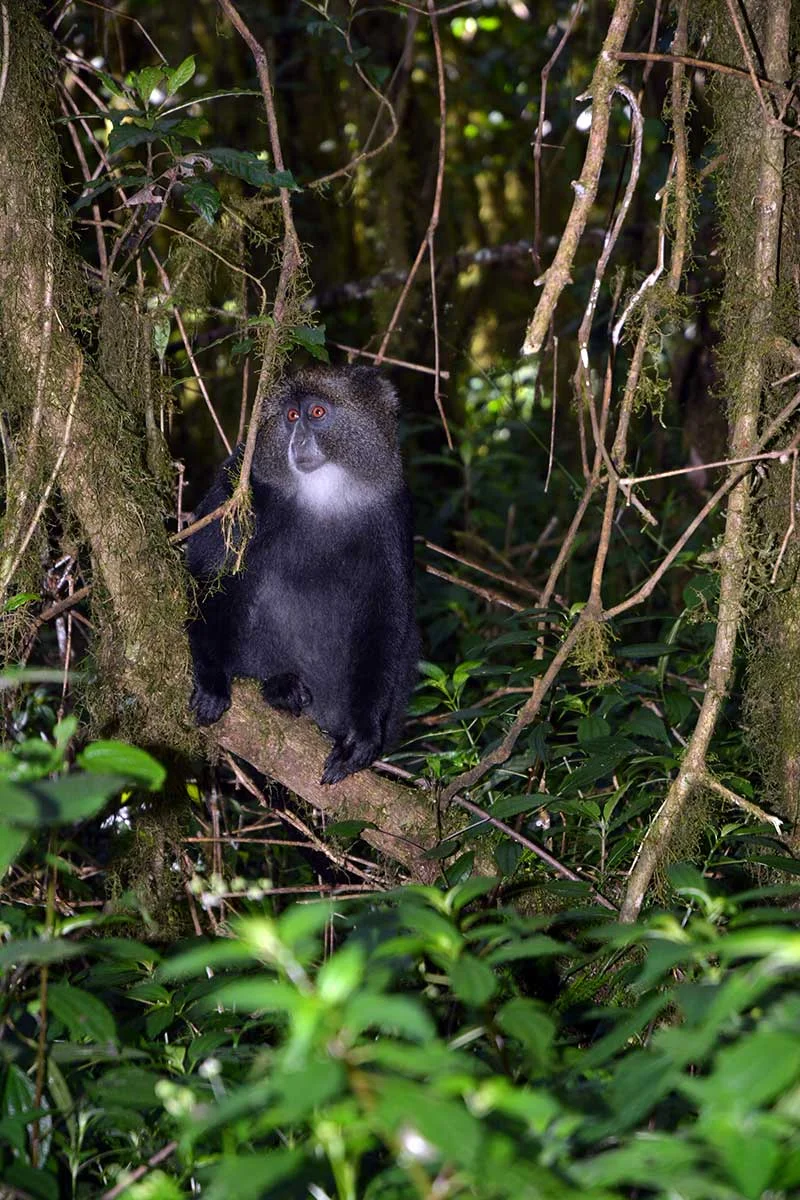
Quick Guide: Animals on Mount Kilimanjaro
| Animal | Best Time to See |
|---|---|
| Colobus Monkey | Morning hours when they feed actively |
| Serval Cat | Early morning or late afternoon |
| Aardvark | Night (nocturnal) |
| Tree Hyrax | Night (most vocal after dark) |
| Duiker | Early morning and late afternoon |
| White-Tailed Mongoose | Late afternoon and early evening |
| Marsh Mongoose | Early morning |
| White-Necked Raven | Daytime (most active during meal hours at camps) |
| Bush Baby (Galago) | Night (nocturnal) |
Best Kilimanjaro Routes for Wildlife Viewing
The route you choose significantly affects your chances of seeing wildlife. Some routes pass through richer rainforest habitat than others, while a few offer unique sightings such as elephants.
| Route | Best Sightings |
|---|---|
| Lemosho Route | Colobus Monkeys, Duikers, Birds |
| Machame Route | Colobus Monkeys, Duikers, Mongoose |
| Rongai Route | Elephants, Colobus Monkeys, Duikers |
| Marangu Route | Birds, occasional monkeys |
Regardless of which route you choose, the first day of trekking offers the best wildlife viewing as you walk through the lush rainforest zone. Ask your guide to point out animal signs such as footprints, droppings, and calls, their local knowledge is invaluable.
Colobus Monkey
Colobus guereza

Colobus Monkey
Colobus guereza
Where can I see Colobus Monkeys on Mount Kilimanjaro?
The Black-and-White Colobus Monkey is one of the most recognizable animals on Mount Kilimanjaro. These beautiful primates live high in the rainforest canopy and move through the trees in family groups. If you spot one, there are usually several others nearby. They are most commonly seen on the Lemosho Route and Machame Route, which pass through prime Colobus habitat.
Colobus monkeys are easily identified by their striking black-and-white fur and their long, flowing tails. They are also known for their loud calls and social behavior. The population found on Kilimanjaro is considered endangered, making every sighting particularly special.
Colobus monkeys are primarily leaf-eaters and have a specialised digestive system that allows them to break down toxic leaves that other monkeys cannot eat. They live in troops of 5 to 15 individuals led by a dominant male. When you hear their distinctive roaring calls echoing through the forest, look up, they are often accompanied by their young, which are born pure white and gradually develop black fur.
Spotting Tip: When you see these monkeys, enjoy the moment and take photographs from a respectful distance without disturbing them.
Serval Cat
Leptailurus serval
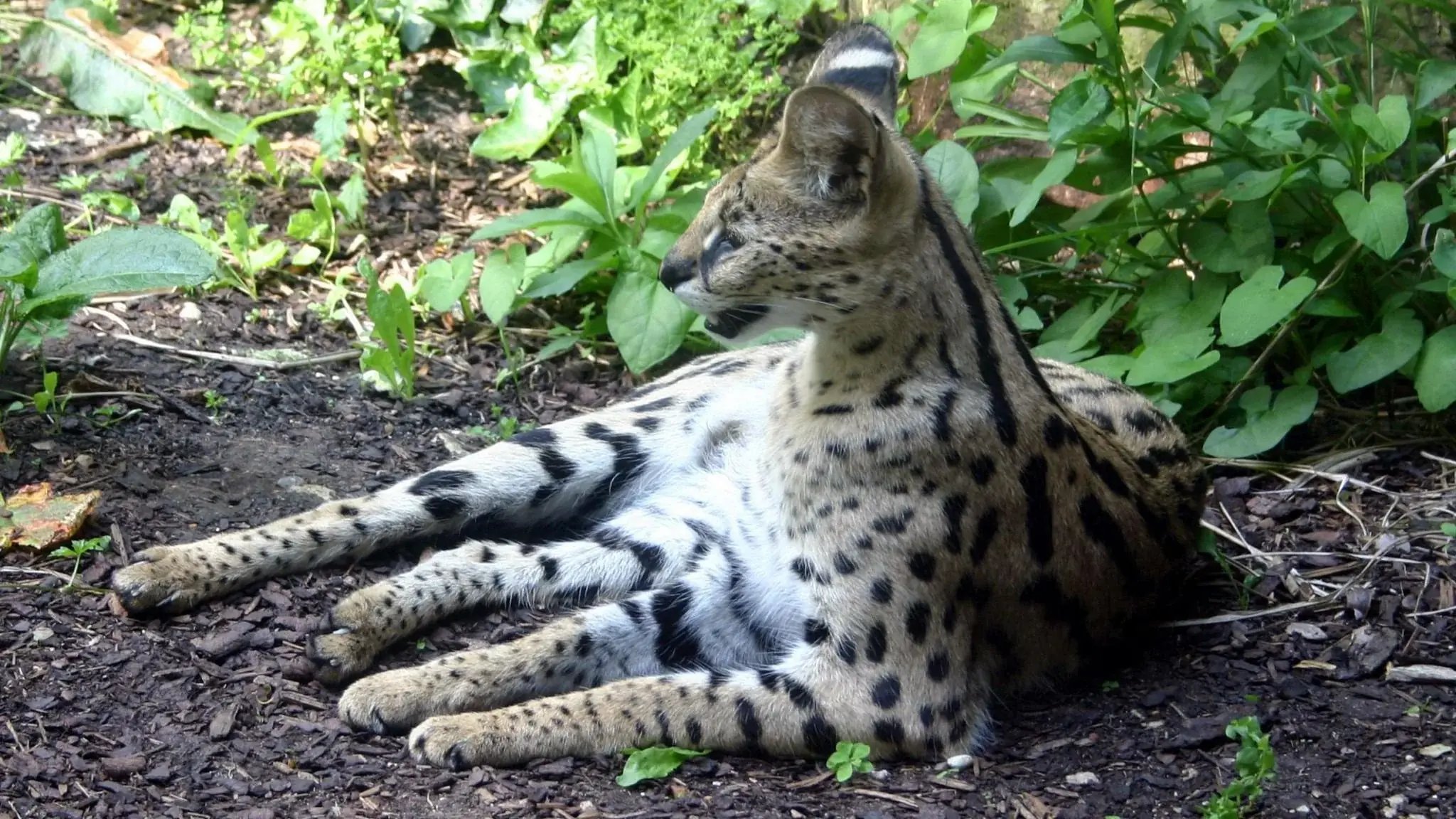
Serval Cat
Leptailurus serval
What does a Serval Cat look like on Kilimanjaro?
Although lions and leopards receive most of the attention in Tanzania, the Serval Cat is another fascinating wild feline that lives around Mount Kilimanjaro.
The serval has a slender body, long legs, large ears, and a coat decorated with black spots and stripes. Its appearance resembles a small cheetah, although it belongs to a completely different species.
Servals are solitary hunters and can be active both during the day and at night. Their diet is incredibly varied and includes rodents, rabbits, birds, reptiles, insects, and occasionally small antelope. Because they are shy and elusive, spotting a serval during your climb is considered a lucky experience.
Unlike many other wild cats, servals have an exceptional hunting success rate, studies show they catch prey in nearly 50% of their attempts, far higher than lions or leopards. Their large ears can detect rodents moving underground, and they use a distinctive high-pounce hunting technique, leaping up to two metres into the air to pin down hidden prey. The lower grasslands near the Londorossi Gate entrance are considered one of the more likely spots for a sighting.
Spotting Tip: Look for servals in grassy clearings near forest edges, especially at dawn and dusk.
Aardvark
Orycteropus afer
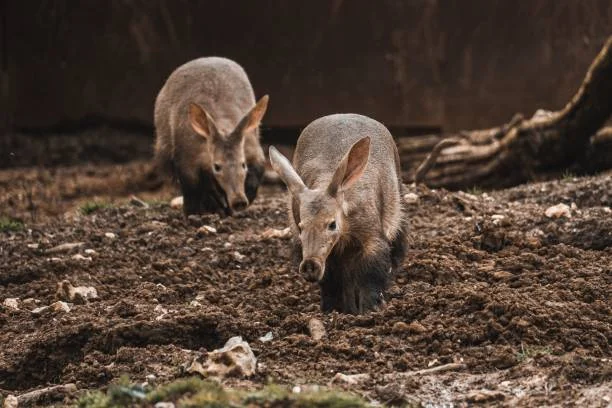
Aardvark
Orycteropus afer
Where do Aardvarks live on Mount Kilimanjaro?
The Aardvark is one of Africa's most unusual mammals. Although it resembles a pig because of its long snout and sturdy body, it is more closely related to elephants than pigs.
This nocturnal animal spends its days hidden underground and emerges at night to search for ants and termites. Its powerful claws allow it to dig efficiently, while its long tongue helps it gather insects from deep inside termite mounds.
Aardvarks can travel considerable distances in search of food, making them one of Kilimanjaro's most fascinating but rarely seen residents.
An aardvark can consume up to 50,000 ants and termites in a single night, using its sticky tongue which can extend up to 30 centimetres. Its powerful claws are strong enough to break open concrete-hard termite mounds, and the abandoned burrows often provide shelter for other wildlife such as warthogs and hyenas. Despite their solitary nature, aardvarks play a vital role in Kilimanjaro's ecosystem by controlling insect populations and creating habitats for other species.
Spotting Tip: Aardvarks are strictly nocturnal. Your best chance is on a guided night walk near park borders.
Tree Hyrax
Dendrohyrax arboreus
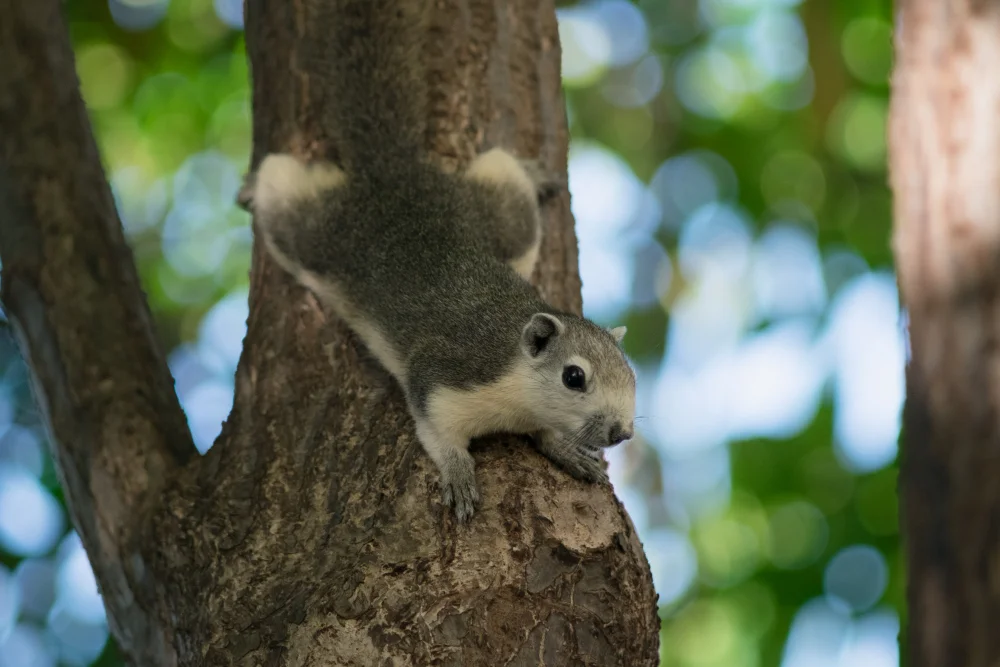
Tree Hyrax
Dendrohyrax arboreus
What sound does a Tree Hyrax make at night?
Another surprising relative of the elephant is the Tree Hyrax. Despite its small size and furry appearance, scientific studies have shown that hyraxes share a distant evolutionary relationship with elephants.
Tree hyraxes inhabit Kilimanjaro's forested slopes and spend much of their time among trees. They are easier to hear than to see. During the evening and throughout the night, they produce unusual sounds ranging from cackles to loud shrieks.
These calls are often used to communicate and establish territory. Hearing a Tree Hyrax during your climb is one of the unique nighttime experiences of Mount Kilimanjaro.
Tree hyraxes have rubbery pads on their feet that act like suction cups, allowing them to climb smooth tree trunks and rocks with ease. They are surprisingly agile for their small size and can navigate the canopy with confidence. Hyraxes live in small family groups and communicate through a complex repertoire of sounds. During the day they sleep in tree hollows, emerging at dusk to feed on leaves, fruits, and bark.
Spotting Tip: Listen for their distinctive shrieking calls after dark, they are far more often heard than seen.
Duiker
Cephalophus spp.
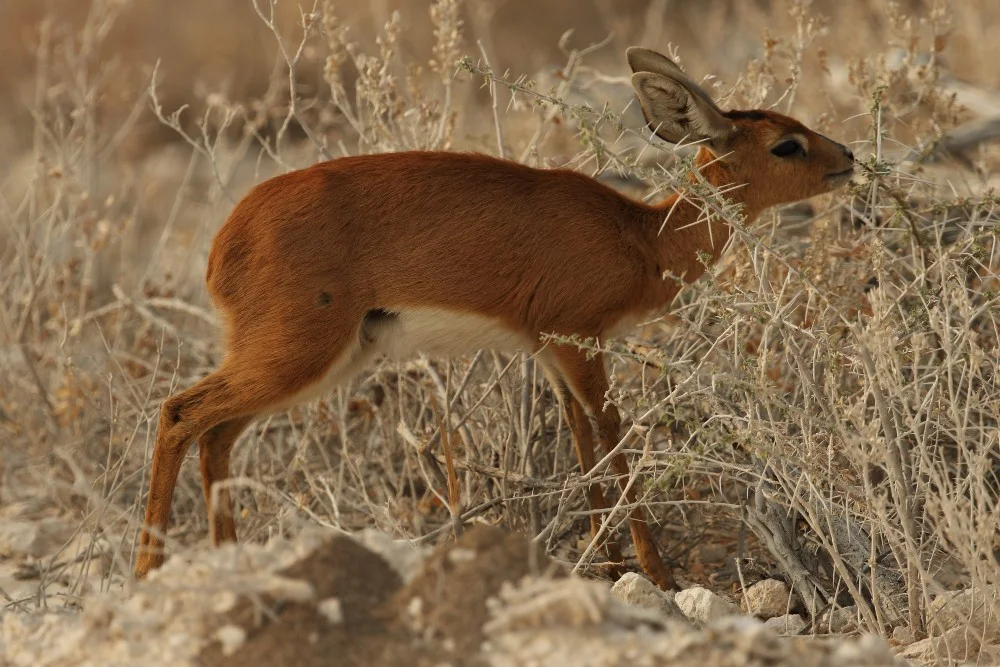
Duiker
Cephalophus spp.
Where do Duikers live on Mount Kilimanjaro?
Duikers are small forest antelopes that thrive in heavily wooded environments. Their name comes from a Dutch word meaning 'to dive,' referring to the way they quickly disappear into thick vegetation when frightened.
Compared with the antelope commonly seen on Tanzania's savannahs, duikers are much smaller and have differently shaped horns and a distinctive hump on their backs.
One particularly special species found on Kilimanjaro is Abbott's Duiker (Cephalophus spadix). This endangered antelope survives in only a few isolated locations in Tanzania, including Mount Kilimanjaro and the Udzungwa Mountains. Habitat loss and deforestation are considered the primary reasons for its decline, according to the IUCN Red List.
Unlike the more common savannah antelopes found on Tanzania's plains, Abbott's Duiker is a shy, solitary creature that prefers dense undergrowth. It stands only about 60 centimetres tall at the shoulder and has a distinctive dark brown coat with a slight reddish tint. Its population on Kilimanjaro is thought to be very small, and ongoing conservation efforts by TANAPA aim to protect the remaining forest habitat that this rare antelope depends on.
Spotting Tip: Move quietly and pause frequently on forest trails, duikers freeze when they sense danger, making them visible if you stay still.
White-Tailed Mongoose
Ichneumia albicauda
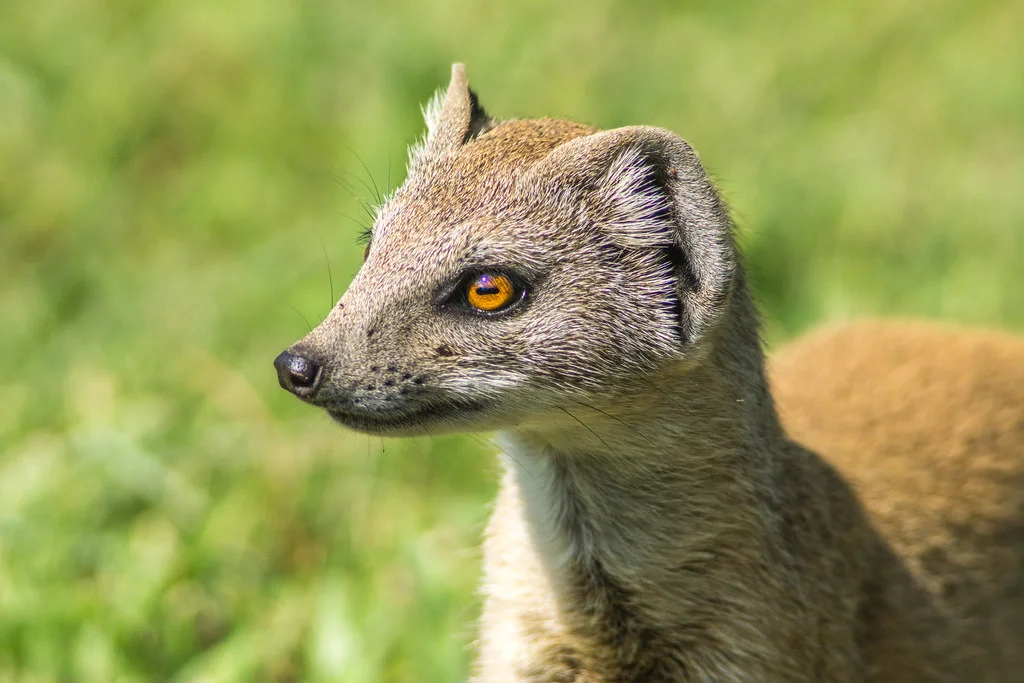
White-Tailed Mongoose
Ichneumia albicauda
How to identify a White-Tailed Mongoose on Kilimanjaro?
The White-Tailed Mongoose is the largest member of the mongoose family and is occasionally seen on the lower slopes of Mount Kilimanjaro.
Its body is generally brown, allowing it to blend into its forest surroundings. However, its long, fluffy white tail makes it easy to identify.
Mongooses are famous for their courage and ability to defend themselves against venomous snakes, including cobras. Like skunks, White-Tailed Mongooses can release a strong musky scent when threatened, so it is always best to observe them quietly and from a distance.
The White-Tailed Mongoose is primarily nocturnal and spends its nights hunting for small mammals, insects, reptiles, and fruits. It has a distinctive walking gait that often looks like it is constantly searching for something in the undergrowth. Despite being the largest mongoose species, it is remarkably stealthy and can disappear into the forest within seconds. Its range extends across much of sub-Saharan Africa, but sightings on Kilimanjaro are always a special treat.
Spotting Tip: They sometimes use the same trails as climbers, watch for movement along the path ahead of you.
Marsh Mongoose
Atilax paludinosus
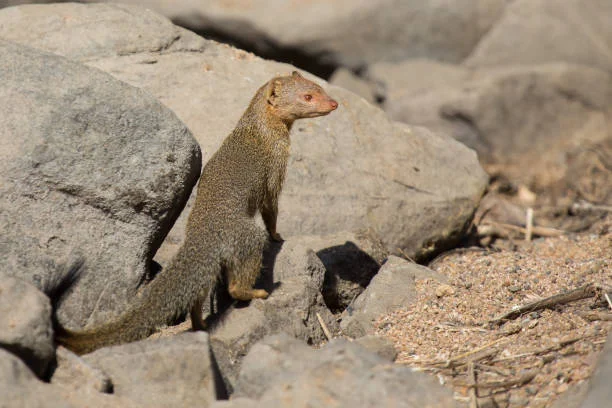
Marsh Mongoose
Atilax paludinosus
Where can I see a Marsh Mongoose on Kilimanjaro?
The Marsh Mongoose is another fascinating member of the mongoose family. Unlike many of its relatives, this species enjoys spending time in wet environments and is an excellent swimmer.
The Marsh Mongoose has developed a clever hunting strategy. It sometimes lies on its back and exposes its pink belly to attract curious birds. When the birds approach, the mongoose quickly catches its prey.
Because these animals often use established paths and trails, observant hikers may occasionally spot them during their Kilimanjaro trek.
The Marsh Mongoose has dense, water-resistant fur and partially webbed feet that make it well adapted to aquatic life. It feeds on crabs, frogs, fish, and small aquatic invertebrates, often foraging along stream banks and marshy areas. Unlike the White-Tailed Mongoose, the Marsh Mongoose is more comfortable in the open and may be seen during daylight hours. The streams and wet areas near the start of the Lemosho and Machame routes are prime locations to look for this species.
Spotting Tip: Look near streams and marshy areas on the lower slopes, they are often found near water sources.
White-Necked Raven
Corvus albicollis
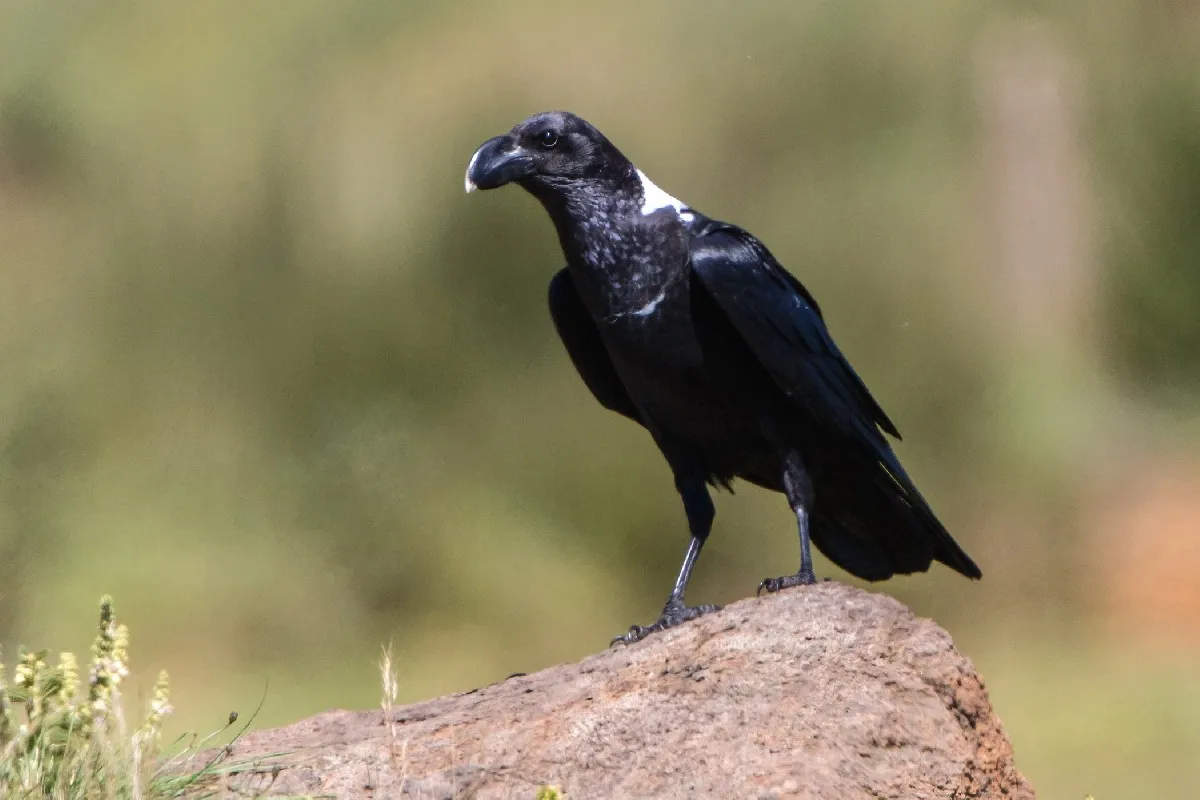
White-Necked Raven
Corvus albicollis
Where do White-Necked Ravens live on Kilimanjaro?
As climbers move higher up the mountain, animal sightings become less frequent. One species that thrives at high elevations, however, is the White-Necked Raven.
This impressive bird has glossy black feathers and a distinctive white patch around its neck. It is highly intelligent and extremely adaptable.
White-Necked Ravens are opportunistic feeders and are known to investigate campsites in search of food. They can open containers and even carry away unattended snacks. Climbers should always secure their food supplies and enjoy watching these remarkable birds from a distance.
These ravens are among the most intelligent birds in the world, with problem-solving abilities comparable to great apes. They have been observed using tools, cooperating with each other to access food, and even recognising individual human faces. Their distinctive white neck patch becomes more prominent as they mature, and their deep, croaking call is one of the most recognisable sounds of the high-altitude camps. At elevations above 4,000 metres, they are often the only animal you will see.
Spotting Tip: Secure your snacks and food bags at camp, these clever birds will open zippers and unwrap food if given the chance.
Bush Baby (Galago)
Galago spp.
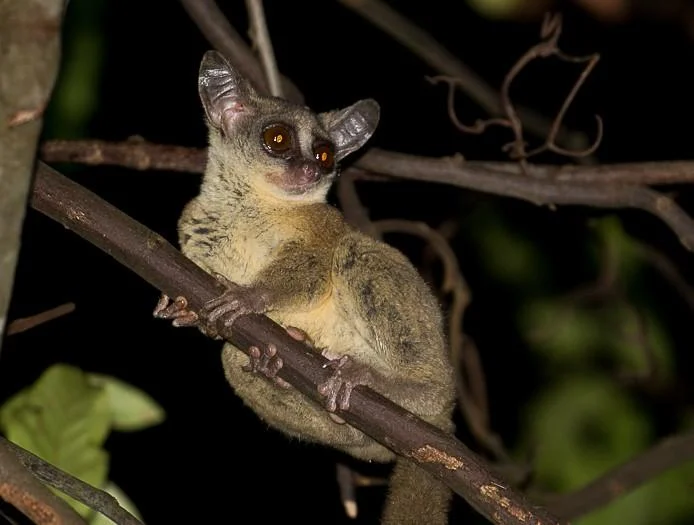
Bush Baby (Galago)
Galago spp.
What is a Bush Baby on Mount Kilimanjaro?
One of Kilimanjaro's cutest residents is the Bush Baby, also known as a Galago. This small nocturnal primate is famous for its large eyes, soft grey or brown fur, and pointed ears that help it navigate the forest at night.
Bush Babies are highly active after dark and move through the trees with impressive agility. Their name comes from their distinctive call, which resembles the sound of a crying baby.
Although they are related to monkeys, Bush Babies have their own unique appearance and behavior, making them one of the most memorable animals that visitors may encounter on Mount Kilimanjaro. Read our complete Bush Baby guide →
Spotting Tip: Shine a torch into the trees near forest camps after dark, their eyes reflect bright orange in the light.
Birds of Mount Kilimanjaro: Over 180 Species
While mammals receive most of the attention, Mount Kilimanjaro is also home to an impressive diversity of birdlife. Over 180 bird species have been recorded on the mountain, ranging from the hardy White-Necked Raven that scavenges at high camps to colourful forest birds in the rainforest zone.
Notable Forest Birds
- • Hartlaub's Turaco, colourful forest bird with a distinctive call
- • Crowned Eagle, powerful raptor, occasionally seen soaring above the canopy
- • African Hill Babbler, shy bird often heard but not seen
- • Kilimanjaro Mousebird, endemic to the mountain's lower slopes
- • African Goshawk, swift forest hawk, patient hunter
High-Altitude Birds
- • White-Necked Raven, the most common bird above 3,000m, highly intelligent
- • Alpine Swift, fast-flying bird seen even near the summit
- • Augur Buzzard, often seen circling above the moorland zone
- • Scarlet-Tufted Sunbird, feeds on lobelia flowers in the moorland
- • Malachite Sunbird, iridescent green, visits heath zone flowers
Birdwatching Tip: Bring a lightweight pair of binoculars (under 500g) and a small field guide. The lower forest trails on the first day of your climb offer the best birding opportunities. Early morning walks are most productive.
Seasonal Wildlife Viewing on Kilimanjaro
While Kilimanjaro's wildlife can be seen year-round, the season you climb affects what you are likely to encounter. The mountain experiences two main seasons that influence animal behaviour and visibility.
Dry Season (June – October)
- ✓ Best visibility, less vegetation, animals more visible
- ✓ Animals gather near remaining water sources
- ✓ Clear weather makes spotting easier on the lower slopes
- ✓ Peak climbing season, more people, but wildlife still active
Green Season (November – May)
- ✓ Lush vegetation attracts more insects and birds
- ✓ Fewer climbers, quieter trails, better wildlife encounter chances
- ✓ Young animals may be present (breeding season for many species)
- ✓ Rain can reduce visibility, but wildlife is still active
For the best wildlife viewing experience, consider climbing during the transition months of June or November, when the trails are quieter but conditions are still favourable. Regardless of the season, early morning starts through the rainforest offer the highest chance of memorable sightings. For more detailed information on weather and timing, read our best time to climb Kilimanjaro guide.
Wildlife Conservation on Mount Kilimanjaro
Mount Kilimanjaro's unique wildlife faces increasing pressure from habitat loss, climate change, and human activity. Several species found on the mountain are classified as endangered or vulnerable, making conservation efforts critical for their survival.
Endangered Species on Kilimanjaro
The Abbott's Duiker (Cephalophus spadix) is classified as Endangered on theIUCN Red List. The Colobus Monkey population on Kilimanjaro is also considered endangered. These species depend on the remaining montane forest, which continues to shrink due to agricultural expansion and logging.
How Climbers Can Help
- • Stay on designated trails to avoid damaging fragile vegetation
- • Never feed or approach wildlife, human food harms their health
- • Pack out all rubbish and food waste
- • Choose responsible tour operators who follow Leave No Trace principles
- • Report any illegal activity such as poaching to park authorities
The Tanzania National Parks Authority (TANAPA)manages Kilimanjaro National Park and works to protect the mountain's biodiversity through ranger patrols, community education programmes, and sustainable tourism policies. Every responsible climber contributes to these conservation efforts.
Kilimanjaro Wildlife Checklist
Use this checklist to track the animals you spot during your climb.
Colobus Monkey
Colobus guereza
Best seen: Morning hours when they feed actively
Serval Cat
Leptailurus serval
Best seen: Early morning or late afternoon
Aardvark
Orycteropus afer
Best seen: Night (nocturnal)
Tree Hyrax
Dendrohyrax arboreus
Best seen: Night (most vocal after dark)
Duiker
Cephalophus spp.
Best seen: Early morning and late afternoon
White-Tailed Mongoose
Ichneumia albicauda
Best seen: Late afternoon and early evening
Marsh Mongoose
Atilax paludinosus
Best seen: Early morning
White-Necked Raven
Corvus albicollis
Best seen: Daytime (most active during meal hours at camps)
Bush Baby (Galago)
Galago spp.
Best seen: Night (nocturnal)
Experience Kilimanjaro's Wildlife with Masatu Tours
The wildlife of Mount Kilimanjaro is one of the mountain's hidden treasures. Every climb offers opportunities to witness nature in its purest form, from playful Colobus Monkeys and rare Abbott's Duikers to intelligent ravens and adorable Bush Babies.
At Masatu Tours, we believe that climbing Kilimanjaro is about more than reaching the summit. It is also an opportunity to discover Tanzania's remarkable biodiversity and appreciate the importance of conservation. Our experienced local guides are passionate about sharing the mountain's wildlife and helping visitors create unforgettable memories.
Plan Your Kilimanjaro AdventureFrequently Asked Questions
Climbers commonly spot Colobus Monkeys, Duikers, White-Necked Ravens, and hear Tree Hyraxes at night. Rare sightings include Serval Cats, Aardvarks, Marsh Mongooses, and Bush Babies. The lower rainforest zone (800–1,800m) offers the richest wildlife viewing. As you ascend above the treeline, wildlife becomes much less common. Read our complete Bush Baby guide →
Related Articles
Amazing Facts About Mount Kilimanjaro
Geology, wildlife, glaciers & records
Animals on Mount Kilimanjaro: 9 Amazing Species
Complete wildlife guide with photos & tips
Dendrosenecio kilimanjari, Giant Groundsel
The iconic plant of Kilimanjaro's high moorland
Complete Big Five Tanzania Guide
Lion, leopard, elephant, rhino & buffalo
Where is Mount Kilimanjaro Located?
Location, climate zones & routes
Do Tigers Live in Africa?
Why tigers are Asian cats, not African
Plan Your 2026-2027 Safari
Complete Tanzania safari planning
Explore Tanzania
Start Planning Your Tanzania Trip
Kilimanjaro climbs, private safaris, and cultural day trips, all with a local Moshi-based operator.
Last updated: July 2026. Species information sourced from the IUCN Red List and Tanzania National Parks Authority (TANAPA). Always follow your guide's instructions and maintain a safe distance from wildlife.
