We live in Africa and take great pleasure in observing a wide variety of animals, many of which are strikingly beautiful and possess intriguing characteristics and habits. Among the most captivating are colobus monkeys, primates with long, flowing fur, endearing faces with broad, protruding noses, and a peculiar missing thumb that gave them their name. If you enjoy wildlife trivia, our Top 25 weird and fun facts about animals is a great place to start.
The Greek word kolobos means "maimed" or "mutilated" — an ironic name for creatures this beautiful. In this article, we explore what makes colobus monkeys so special, from their unusual digestive systems to their luxurious fur, and exactly where you can see them in the wild.
Safari Guide's Note
If you're staying in hotels near Arusha or Moshi, you may see colobus monkeys right from your hotel garden. We see them every time we stay in the Usa River area — jumping through the trees right above our heads. Just let our team know and we'll arrange accommodation where these beautiful primates are your morning alarm clock.
Colobus Monkeys: Quick Facts
Common Name
Mantled Guereza
Scientific Name
Colobus guereza
Class
Mammalia
Continents
Africa
Lifespan
~20 years
Diet Type
Herbivorous (leaves, fruits, flowers)
Size
45–72 cm body length
Weight
5–14 kg
IUCN Status
Least Concern (population declining)
Distinctive Trait
Reduced thumb (vestigial stump)
Stomach
Multi-chambered, like a cow's
Species Count
20+ species across 3 genera
The Missing Thumb: Deformity or Advantage?
When you see colobus monkeys in their natural habitat, you wouldn't think there's anything unusual about their hands. These agile tree-dwellers leap from branch to branch over great distances, keeping up with their fellow primates. What's even more fascinating is that they are considered the most arboreal of all primates, spending most of their lives in the trees and only coming down to the ground in extreme situations when there's no other way through the treetops.
The reduced thumb is not a deformity but an advantage. The smaller size indicates evolutionary adaptations resulting from their tree-dwelling lifestyle. The same kind of changes can be observed in spider monkeys from North and South America, which also live almost entirely in the canopy.

Since colobus monkeys move along the highest branches and feed exclusively on leaves, fruits, and flowers, they don't need specialized tools to obtain food. They use their limbs solely to leap from branch to branch and gather vegetation. The opposable thumb, which is common among most primates, simply became unnecessary for them.
Colobus monkeys enjoy sitting or semi-lying on the branches but never hang from them. When they eat, they do so from the top of the branch, using their hands to pluck leaves. It's all interconnected: the shape of their hands, their habitat, the way they move, and their diet all work together in a beautifully adapted system.
Unusual Diet and Strong Stomachs
Why do colobus monkeys rarely descend to the ground, spending so much time in the trees? During the evolutionary arms race when various animals were actively spreading across Africa, they had to compete for space and limited resources. The genera and species of monkeys were growing, with one group displacing another. Colobus monkeys climbed higher and higher, looking for food that other primates did not claim — poisonous plants. This is how they adapted to the existing conditions.
Colobus monkeys have a complex and unusual digestive system. Food is processed in their foregut, even before it reaches the further parts of the intestine. Their stomach is multi-chambered. When tough and poisonous leaves enter the foregut, bacteria process them through a detoxification process. They then move on already neutralized, entering the intestine without toxins.
Colobus monkeys are the only primates capable of consuming poisonous plants without harming themselves. Similar adaptations can be found in the stomachs of sloths, kangaroos, and some ruminants. However, unlike the South American hoatzin bird — nicknamed the "stinkbird" due to its fermentation smell — colobus monkeys produce no unusual odors thanks to their internal digestion.
Did You Know?
The complex multi-chambered stomach gives colobus monkeys several advantages: their fiber digestion is more efficient than in other monkeys, and they extract more protein from their food. As a result, these beautiful creatures consume more leaves and obtain greater energy from them than any other primate.
Luxurious Fur
Such beautiful creatures are hard to find: long fur, huge fluffy tails, and striking black-and-white patterns. And how gracefully they sit atop the treetops! True kings of the upper canopy in Africa's forests.
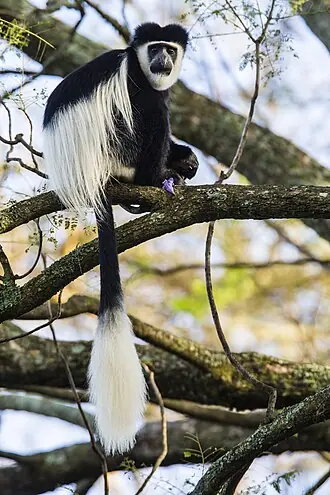
There are three genera of colobus monkeys: black-and-white colobus (genus Colobus), red colobus (genus Piliocolobus), and olive colobus (genus Procolobus). There are six species within the Colobus genus, and all share the primary color of their fur — black. The two most prominent representatives are the Mantled guereza (Colobus guereza) and the Angola colobus (Colobus angolensis).
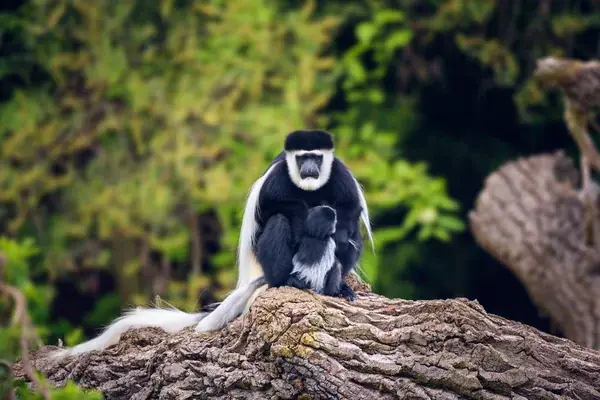
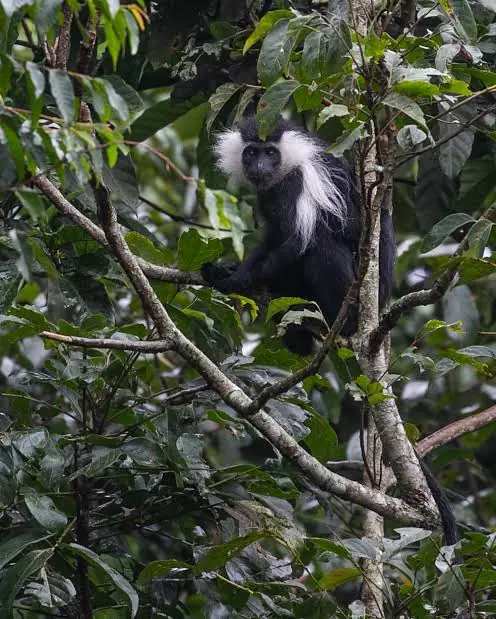
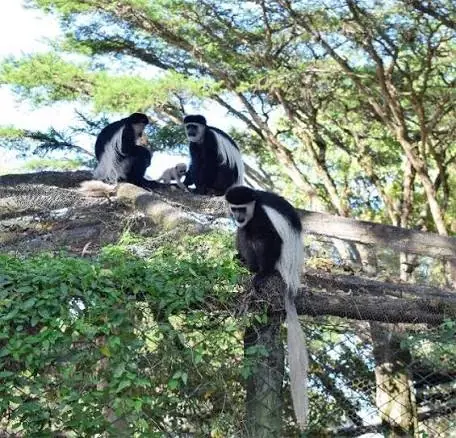
White fur frames the faces of these species and descends from their shoulders to form a mantle on their sides. Their tails are also white: in the Angola colobus, tails can be either black or white, but the tip is always white. In the Mantled guereza, the entire fluffy lower part of the tail is snow-white. It's truly impressive to see their magnificent, drooping tails as they sit high in the trees, calmly observing their surroundings while having a meal.
The length of the fur varies from species to species and depends on habitat. Colobus monkeys prefer the gallery forests of tropical Africa and mangrove thickets. They also inhabit meadows with trees, bamboo and eucalyptus plantations, and mountain forests at elevations up to approximately 3,300 meters (about 10,826 feet). The higher above sea level they live, the longer their fur — they need more protection from the cold at higher altitudes.
Colobus monkeys acquire their impressive fur length and coloration with age. Newborn monkeys are completely white, with only their faces being pink. By three months, their fur becomes black and takes on the distinctive shades characteristic of each species.
A History of Exploitation
As often happens with beautiful animals, colobus monkeys have suffered from excessive human attention. Their fur was used for trimming coats, capes, hats, and dance costumes. They were hunted in the forests and their skins shipped by hundreds of thousands annually. By the early 20th century, several subspecies had been exterminated. Fortunately, the fashion for monkey fur waned, but even today they are still hunted for their beautiful fur on the black market.
The Mount Kilimanjaro Guereza
Since the late 19th century, there has been a debate about a distinct population of black-and-white colobus monkeys in the forests of Mount Kilimanjaro, Mount Meru, and their surrounding areas. Researchers who classify them as a separate species call them the Mt. Kilimanjaro guereza (Colobus caudatus). They have perhaps the longest fur and the most luxurious tails of any colobus.
In 2020, the IUCN finally announced their classification as a separate species. The reasons included a distinctive skull structure different from all other species, geographic isolation from other subspecies of the Mantled guereza, and a declining population classified as Vulnerable. In Tanzania, more than 10,000 individuals are counted, but in a couple of small forest reserves in neighboring Kenya, there are only about 200.
Not All Colobus Are Black and White
In Africa, you can find not only black and white colobus monkeys but also ones with reddish and reddish-brown fur, and even olive-green shades. The tribe Colobini includes three genera:
Black and white colobuses (genus Colobus) — 5 or 6 species, all primarily black with white markings
Red colobuses (genus Piliocolobus) — about 20 species, tricolored with brown, orange, or reddish fur
Olive colobuses (genus Procolobus) — just one species, with greenish-brown or olive fur
Most of the so-called black-and-white colobus monkeys live up to that name, although only two or three species have full white mantles and tails. The others have white markings on various parts of their body, often around the face and at the tip of the tail. Only the black colobus (Colobus satanas) has no white markings at all, remaining entirely black.
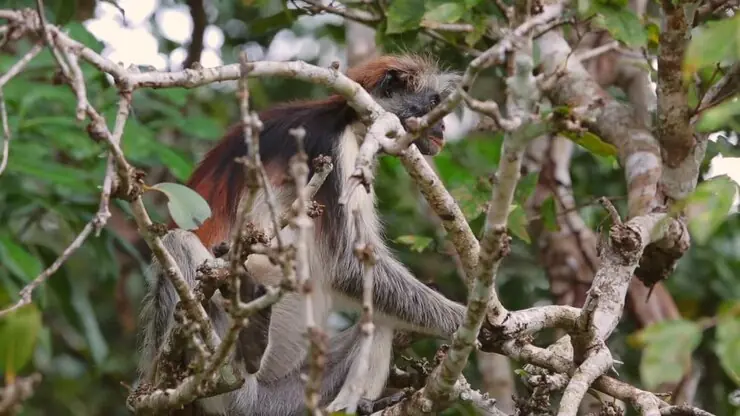
The red colobus species can be tricolored: in addition to black and white, their fur includes various shades of brown, orange, or reddish, and often gray. This diversity makes the colobus family one of the most visually varied primate groups on the planet.
The Zanzibar Red Colobus
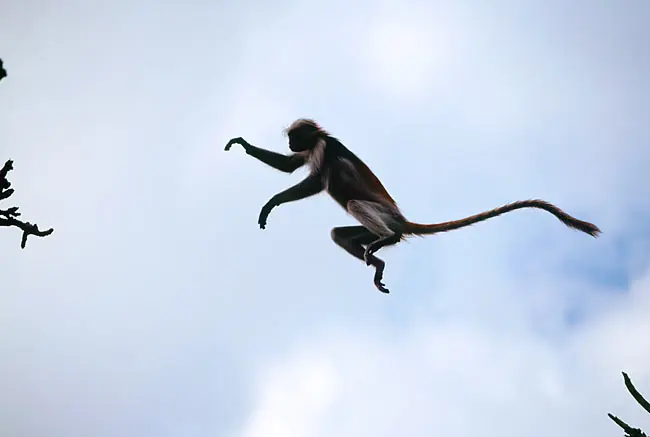
Among the most famous red colobus is the Zanzibar red colobus (Piliocolobus kirkii), which has a distinctive red or reddish back. It was named after the Scottish naturalist John Kirk, who explored the animals and plants of East Africa, including Unguja Island (Zanzibar).
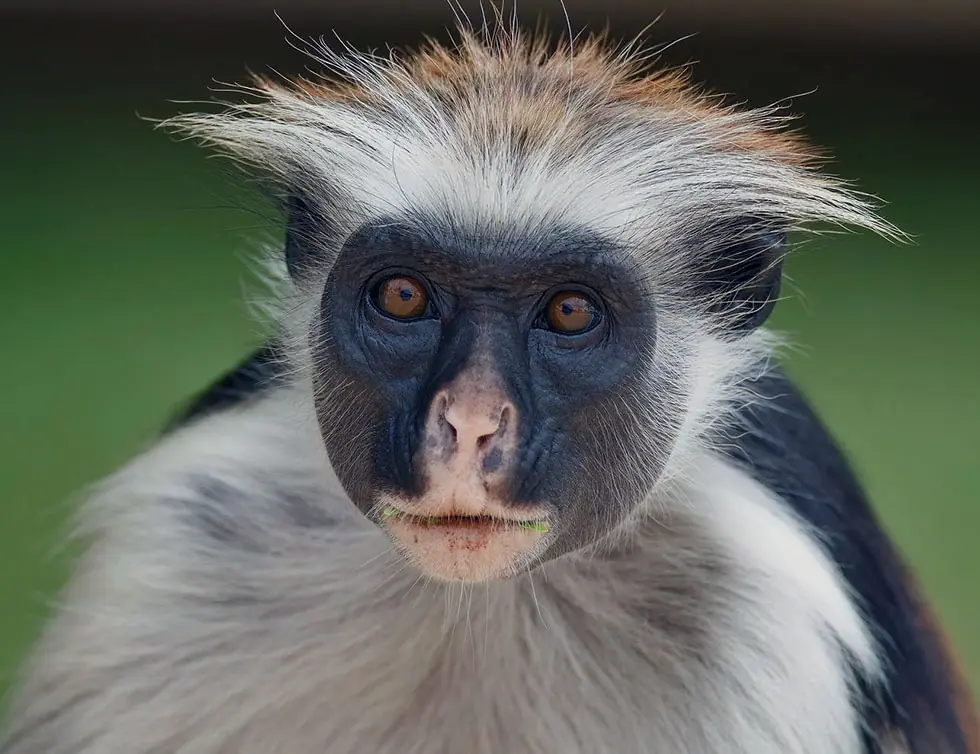
The Zanzibar red colobus inhabits the only remaining forest in Zanzibar. Currently, their population numbers fewer than 6,000 individuals, and they are classified as Endangered. Efforts were made to relocate them to the neighboring island of Pemba, but the population couldn't increase due to conflicts with humans. Superstitious farmers killed the animals, believing they brought bad luck.
Habitat loss remains the most significant threat across all colobus species. People are actively clearing forests — the cherished and familiar shelters of these monkeys — for agriculture and development. While the number of colobus monkeys killed by humans has reduced compared to the 19th and 20th centuries, the ongoing destruction of their forest homes continues to put pressure on populations.
Who Hunts the Colobus Monkeys?
Besides their main enemy — humans — colobus monkeys face several natural predators. In the wild, leopards, chimpanzees, and large birds of prey regularly hunt them. The Mantled guereza often falls victim to crowned eagles and Verreaux's eagles, which can spot their white mantles from high above the canopy.
When settling down for the night on branches in the middle and upper parts of the forest, black-and-white colobus monkeys sleep quite alertly, preventing predators from getting too close. On bright moonlit nights, they sleep more soundly, but in the dark they're more tense, signaling alarms to other group members if danger is present.
Their Signature Call
You can easily identify colobus monkeys by their sound — they emit a recognizable roar in the forest that carries up to 1.5 kilometers. Males use this to show group members where they are and to warn other groups away from their feeding territories. In danger, they produce snorting sounds, squeals, and deafeningly high screams if females and juveniles are threatened.
When a predator attacks, the alpha male jumps and growls, drawing attention to himself and allowing the rest of the group to hide. Colobus monkeys can cover impressive distances of several meters in a single jump, leaping from branch to branch with remarkable agility.
Where to See Colobus Monkeys in the Wild
Colobus monkeys have a wide range of habitats across the tropical belt of Africa, from Senegal in the west to Ethiopia in the east, spreading south to Angola and Zambia, and encompassing certain regions of Tanzania.
In Tanzania specifically, you can find several species:
Mt. Kilimanjaro & Mt. Meru
Home to the Kilimanjaro guereza (Colobus caudatus), found in forests around both mountains and in Arusha National Park
Northern Tanzania Forests
Mantled guerezas live extensively in Kenya and northern Tanzania, particularly around Arusha and Moshi
Central & Southern Africa
Angolan colobus monkeys are found across the DRC, Rwanda, Burundi, and in a large belt through Tanzania
Zanzibar
The Zanzibar red colobus is found only in Jozani Forest on Unguja Island — nowhere else on Earth
You can spot these species of colobus on a safari trip to East Africa by visiting Arusha National Park and the forests around Mount Kilimanjaro. If you've planned a trip to the Serengeti and Ngorongoro, you don't necessarily have to visit less popular parks. Colobus monkeys live in the trees in green areas around Arusha and Moshi — even in hotel gardens.
Frequently Asked Questions
See Colobus Monkeys on Safari
You can see colobus monkeys on any Masatu Tours safari program. All of our safaris include visits to national parks and forested areas where colobus monkeys live in their natural habitat. Ask your guide to look for them, and if possible, visit their habitats where the chances of spotting these beautiful primates are highest.
Best Time to See
Colobus monkeys are active year-round. Early morning and late afternoon are the best times to spot them, when they forage actively in the canopy. They are especially visible when sunning themselves on branches after cool nights.
Where to Look
Focus on forested areas and canopy edges. Near Arusha, the Usa River area and Arusha National Park are excellent. Around Kilimanjaro, the lower forest belt offers great sightings. Listen for their distinctive roaring calls.
How to Spot Them
Look up! Colobus monkeys are almost always in the canopy. Their white mantles and long white tails contrast sharply against the green foliage, making them easier to spot than many other primates once you know where to look.
Responsible Viewing
Keep a respectful distance, stay quiet, and never attempt to touch or feed colobus monkeys. Ethical observation ensures these magnificent primates remain wild and healthy for generations to come.
Experience Tanzania's Wildlife with Masatu Tours
Choose any Masatu Tours safari and see colobus monkeys in the wild, in their natural habitat. Our expert guides know exactly where to look, and every safari is designed for responsible, unforgettable wildlife viewing.
Conclusion
Colobus monkeys are among Africa's most beautiful, fascinating, and underappreciated primates. From their unique missing thumb and cow-like multi-chambered stomach to their magnificent flowing fur and dramatic territorial calls, every aspect of these monkeys tells a story of remarkable evolutionary adaptation.
Tanzania offers some of the finest colobus viewing on Earth, from the forests of Mount Kilimanjaro to the gardens of Arusha and the ancient Jozani Forest on Zanzibar. The best part? You don't need to go far off the beaten path — these stunning monkeys are often closer than you think.
Plan Your Tanzania Safari
Ready to see colobus monkeys and other incredible wildlife in their natural habitat? Our expert-led safaris take you to Tanzania's finest parks with guides who know the bush like the back of their hands. Talk to a safari expert today.
Talk to a Safari ExpertRelated Wildlife Guides
13 Iconic Rainforest Animals
From the okapi to the green anaconda
Serval Cat, Complete Guide
Africa's long-legged wild cat
Honey Badger Guide
Africa's most fearless animal
Bush Baby (Galago) Guide
Africa's adorable nocturnal primate
Animals on Mount Kilimanjaro
Wildlife on the roof of Africa
Big Five in Tanzania
Lion, leopard, elephant, rhino & buffalo
Arusha National Park
See colobus monkeys in their natural habitat
Tanzania Safari Packages
Plan your dream wildlife safari
Birdwatching in Tanzania
Discover Tanzania's incredible birdlife
Last updated: August 19, 2026. All facts verified against IUCN data and current wildlife research.
