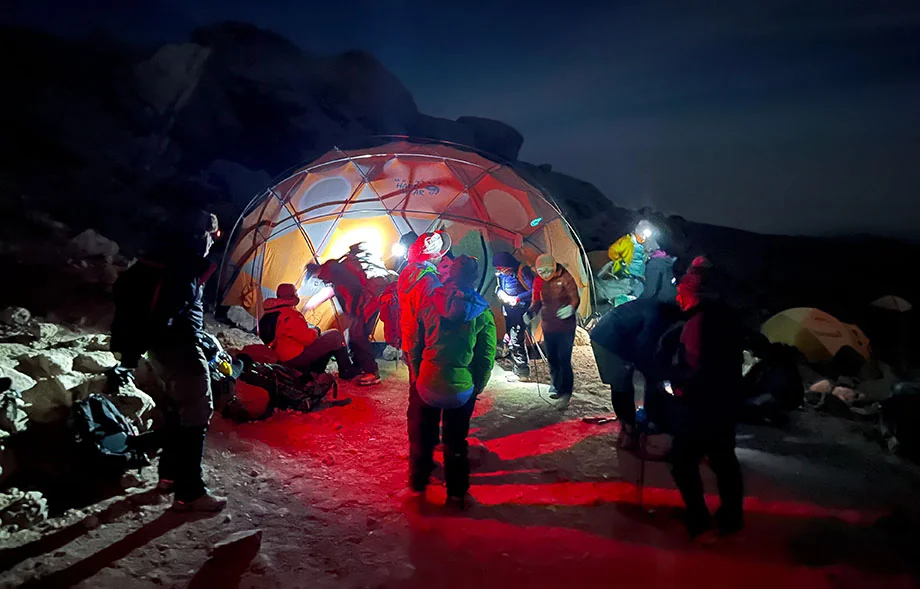
Picture day four on Northern Circuit. You leave Moir Hut in the thin morning light, 4,200 metres up, and turn onto a trail that almost no one uses. Behind you, the southern routes are carrying hundreds of climbers toward the same summit. Ahead of you, the northern face of Kilimanjaro runs for kilometres with nobody on it but your group. That is Northern Circuit: the longest, quietest, and statistically safest way to the roof of Africa.
Every route on the mountain gets you to Uhuru Peak. Northern Circuit gets you there by circling most of the way around the mountain first, crossing the Shira Plateau, traversing the remote northern face across three full days, and only then turning for the summit. Those extra days cost money and time, which is why the route stays quiet. What you buy with them is the best acclimatization profile on the mountain, and a success rate that most routes can only dream of.
Guide's Note
Northern Circuit is the right choice when summit success is your priority and you have the days and budget to do it properly. It is not the route to pick if time or money is tight; that is Lemosho 8-day territory. Nine days on the mountain is the price of the mountain's best odds, and for the right climber it is worth every day.
Dry Season, Recommended
January to February and June to October give firm trails, clearer views, and the best chance of a clean summit morning. February is the driest month of the year. July and August are excellent, and because Northern Circuit is the least-trafficked route, even the busy months stay quiet on the traverse.
Rain Shadow, A Real Edge
The northern slopes sit in a rain shadow, so the traverse sees less precipitation than the southern routes during wetter spells. March to May and November remain less certain overall, but Northern Circuit is the best-performing route in the short rains. More detail in our month-by-month weather guide.
Northern Circuit 9-Day Quick Facts
Best Months
January–February & June–October
Typical Price
$2,700–$4,900+ per person
Duration
9 days / 8 nights on the mountain
Success Rate
~90–95%, the highest of any route
Highest Point
Uhuru Peak, 5,895 m
Route Length
~90 km around the whole mountain
Northern Traverse
Days 4–6, the quietest trail on Kili
Nights Above 3,900 m
5, more than any other route
Traverse Camps
Moir Hut → Buffalo → Third Cave
Summit Push
4,700 m → 5,895 m overnight
Shared Start
First 3 days on the Lemosho trail
Certificate
Uhuru Peak, issued at Mweka Gate
What Makes Northern Circuit Unique
Northern Circuit is not a longer version of another route. It is the only standard route that crosses the mountain's northern face, and that single fact changes almost everything about the experience.
The only full northern traverse
Every other route approaches the summit from the south or east. Northern Circuit is the only one that crosses the northern face, which means the quieter, more remote, and in many ways more dramatic side of the mountain is effectively exclusive to this route.
Dramatically quieter trail
On Days 4 through 6 you may go entire days without seeing another climbing group. After years of seeing photos of Kilimanjaro packed with single-file queues, this absence of crowds is one of the most striking parts of the whole trip.
Superior acclimatization profile
The extra days traversing between 3,900 m and 4,200 m are not filler. They are genuine physiological acclimatization: more red blood cells, adjusted respiratory chemistry, and a tolerance for altitude that translates directly into summit-night performance.
Northern ice field views
Between Moir Hut and Third Cave Camp on a clear day, Kibo's northern glaciers sit directly above you, a perspective almost no Kilimanjaro climber ever encounters. The traverse is where the mountain shows you its private side.
Day-by-Day Itinerary
Day 1: Londorossi Gate / Lemosho Glades → Mti Mkubwa Camp
The approach to Northern Circuit begins at the same remote western trailhead as Lemosho, two hours from Moshi by road through farmland that gradually gives way to the national park's forest belt. The first day is a gentle walk through ancient montane forest, giant podocarpus trees, moss-draped trunks, colobus monkeys moving through the canopy overhead. Day 1 is short by design. Reach Mti Mkubwa (Big Tree Camp), set up, eat a full dinner, and sleep early. The mountain is patient; use the first evening to settle into its rhythm.
Day 2: Mti Mkubwa → Shira 1 Camp
The forest thins and the heather zone begins. Views that were blocked by dense canopy for the first 24 hours open up as the trail climbs onto the western moorland. This is a sustained, consistent ascent, more demanding than Day 1, and it brings you to the edge of the Shira Plateau by late morning. Shira 1 Camp sits at 3,500 metres in open terrain with wide-angle views of the summit cone to the east. The altitude starts registering here. Drink consistently and eat a full dinner.
Day 3: Shira 1 → Shira 2 Camp
A shorter day that crosses the full breadth of the Shira Plateau, one of the most striking landscapes on Kilimanjaro. The plateau is an ancient, eroded volcanic caldera now worn into a wide, windswept highland, and walking across it with Kibo's summit cone dominating the sky ahead is memorable. This crossing is identical to the Lemosho route; from Day 4 onward the two routes diverge. Use this gentle day to acclimatize at 3,840 metres. Your body is working hard even when you feel fine.
Day 4: Shira 2 → Moir Hut
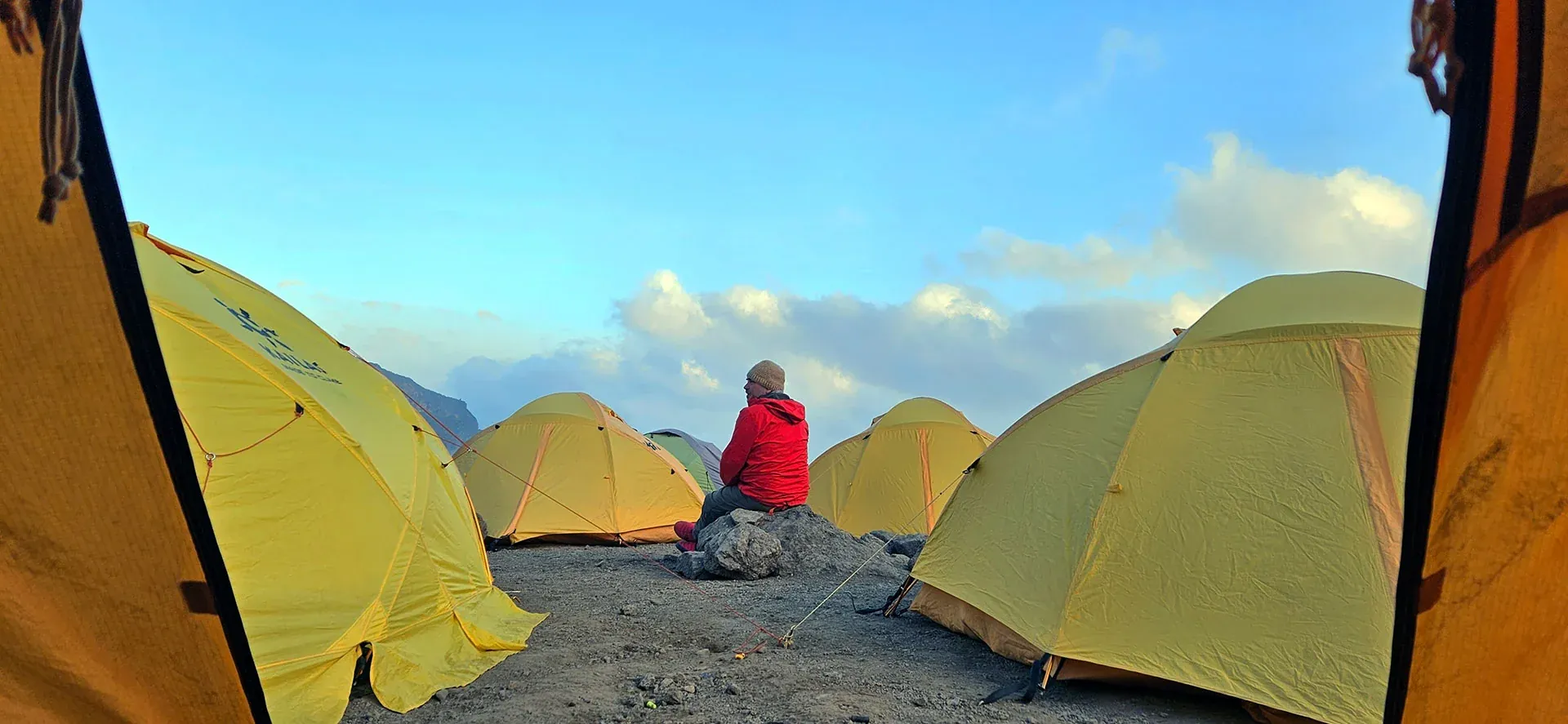
This is where Northern Circuit separates from every other Kilimanjaro route. Instead of heading southeast toward Lava Tower and the main routes, the trail turns north. Within a few kilometres the trail traffic drops to almost nothing. The landscape changes: drier, more exposed, with different vegetation and a genuine sense of remoteness. Moir Hut (4,200 m) is a small, functional camp with outstanding views north across the Amboseli plains. The altitude here is real, and headaches are common and expected. Eat, drink, and rest.
Day 5: Moir Hut → Buffalo Camp
One of the most demanding days of the traverse in distance and exposure. The trail contours below the northern icecap across open ground with little shelter from wind, and views of Kibo's northern ice fields, visible only from this angle, are extraordinary on clear days. Buffalo Camp sits just below 4,000 metres at the end of a long day. Start early, by 07:00, to beat the afternoon cloud and wind that build fast on the exposed northern face. This is a remote camp; there is no infrastructure beyond what your crew carries.
Day 6: Buffalo Camp → Third Cave Camp
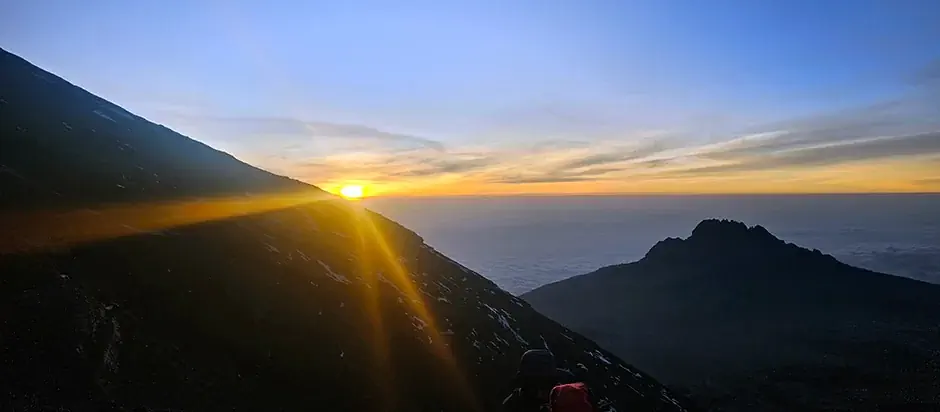
The traverse continues east, and Mawenzi Peak dominates the view ahead, its jagged, eroded silhouette dramatic against the sky in a way that southern-route climbers rarely see clearly. The terrain is varied, crossing shallow valleys and open ridgelines. Third Cave Camp is named for natural rock overhangs nearby that have sheltered climbers for generations. By now, three days of traversing above 3,900 metres have done real physiological work. Your body is adapting to altitude more effectively than any shorter-route climber's will.
Day 7: Third Cave Camp → School Hut / Kibo Hut Area
The northern traverse ends as the trail climbs back toward the main route infrastructure near School Hut and the Kibo Hut area. This is a significant altitude gain, from 3,900 m to 4,700 m, on what feels like a short day. You will begin seeing other climbers again for the first time since Day 4. The alpine desert zone is barren, cold, and windswept. Set up camp, eat everything on your plate, drink consistently, and lay out your summit gear before trying to sleep in the afternoon.
Day 8 / Summit Night: School Hut → Uhuru Peak → Millennium or Mweka Camp
Departure around 23:00. The ascent is the same as on any route staging from the Kibo Hut / School Hut area: steep scree, darkness, cold, one deliberate step at a time, with your guide setting the pace. Stella Point on the crater rim (5,739 m) arrives at or around first light after several hours of grinding upward, and Uhuru Peak (5,895 m) is another 45 minutes along the rim. After the summit, a long descent, typically to Millennium or Mweka Camp at 3,100 m, returns you to oxygen-rich air by early afternoon.
Day 9: Final Camp → Mweka Gate
The final descent through recovering rainforest is warm, green, and full of the sounds of birds and running water after eight days of high-altitude silence. Collect your summit certificate at Mweka Gate; TANAPA issues certificates for Gilman's Point and Uhuru Peak separately, so bring your summit record. Then transfer back to Moshi. Nine days after entering the mountain, you are done.
Why the Success Rate Is the Best on the Mountain
Altitude sickness is a numbers game. The single biggest predictor of summit success is how long your body has had to adapt before the final push, and no other route gives you as much adaptation time as Northern Circuit. You sleep at or above 3,900 metres for five nights, three of them spent gently traversing rather than climbing hard, before you ever point at the summit.
Compare that with the 6-day Lemosho or Marangu schedules, which compress acclimatization into two or three nights above 3,500 metres. On Northern Circuit, by the time you reach School Hut (4,700 m) on Day 7, your body has already been adapting for nearly a week. The result is the 90 to 95 percent summit rate that operators consistently report for well-prepared groups.
~90–95%
Summit success rate
5 nights
Above 3,900 m, more than any route
3 days
Gentle traverse above 3,900 m
1,195 m
Summit push from School Hut
Best Odds Does Not Mean Guaranteed
Even on Northern Circuit, success depends on arriving fit, pacing yourself on summit night, and trusting your guide's calls on your body. No route removes the risk entirely. What the nine-day profile does is remove most of the avoidable reasons people turn around, which is exactly why the rate sits where it does. For the wider picture across all routes, read our honest success-rate guide.
Who Northern Circuit Suits Best
Northern Circuit is not the right choice for everyone. It costs more, takes longer, and demands comfort with remoteness. But for the right climber it is the best route on the mountain. If you recognise yourself in any of these four profiles, it deserves a serious look.
Climbers prioritising summit success
If reaching the summit is genuinely non-negotiable, a once-in-a-lifetime trip, a bucket-list item, or a personal challenge you have waited years for, Northern Circuit's extended acclimatization gives you the best statistical chance of standing on Uhuru Peak. The 90 to 95 percent success rate is the physiological payoff of nine days at altitude.
Experienced trekkers wanting remoteness
If you have done high-altitude treks before and the idea of sharing the trail with dozens of climbers is unappealing, Northern Circuit delivers days of genuinely quiet trail. The northern traverse is the least-trafficked section of any standard route, and the difference between a mountain and a queue is defining.
Climbers with prior altitude issues
If previous high-altitude attempts ended in altitude problems, or you know your body responds better to slow, gradual exposure than compressed schedules, the nine-day profile addresses that directly. The extra nights above 3,900 metres make a measurable physiological difference.
Those who want the full Kilimanjaro experience
If you are not just trying to bag the peak but want to genuinely experience the mountain across multiple climate zones and landscapes, Northern Circuit delivers. The northern face traverse, the Shira Plateau crossing, the ice-field views, and the sense of a near-complete circumnavigation add up to a richer trip than any other route provides.
Cost Breakdown for 2026 & 2027
Northern Circuit costs more than other routes because it is genuinely longer and more logistically demanding. Here is how the market breaks down in practice. Our full cost guide covers the wider picture.
Value
$2,700–$3,400
Smaller operators running group departures. Workable if you research the operator carefully, but the northern traverse is remote enough that crew experience and safety equipment matter more than on busier routes. Confirm both before booking.
Mid-RangeRecommended
$3,400–$4,200
Reputable operators with experienced guide teams, private vehicle transfers, quality mountain food across all nine days, and proper safety equipment including supplemental oxygen and pulse oximeters. This is the tier where the service matches what a nine-day remote traverse warrants.
Premium
$4,200–$4,900+
Private group setup, satellite communication, enhanced crew ratios, improved camp meals across the full nine days, and gear rental options. The right call for once-in-a-lifetime trips where no-compromise service is the point.
Why the Price Is Higher, the Honest Version
Nine days on the mountain means two extra days of TANAPA park and camping fees (roughly $70 to $90 per person per day), two more days of guide and porter wages, two more days of mountain meals, and the additional logistics of the remote northern traverse. A Northern Circuit quote that is not meaningfully higher than an 8-day Lemosho quote should raise questions about what has been cut.
What Is Included and What Is Not
Included in a standard Northern Circuit package
- TANAPA park, camping, and rescue fees for all nine days
- Licensed lead guide, assistant guide(s), cook, and porters
- All mountain meals: breakfast, lunch, and dinner across nine days
- Tents, sleeping mats, and dining tent
- Safety equipment: supplemental oxygen, pulse oximeter, first-aid kit
- Moshi–Londorossi Gate–Mweka Gate–Moshi transfers
- Summit certificate at Mweka Gate
Not included, budget separately
- International flights and Tanzania visa ($50–$100)
- Travel insurance with high-altitude medical evacuation cover
- Personal gear (sleeping bag, boots, cold-weather layers) or gear rental
- Crew tips, $250–$400 per person is standard for a nine-day climb
- Pre/post-climb hotel accommodation in Moshi
- Snacks, energy gels, personal medications, power bank
5 Practical Tips for Northern Circuit Climbers
The nine-day format changes what matters compared with the shorter routes. Start with these five, and pair them with our training guide and packing list.
The northern traverse feels remote, that is the point, but prepare mentally
Days 4 through 6 on the northern face have minimal infrastructure. There are no bail-out routes to lower altitude, no other climbers visible, and no facilities beyond your crew's camp equipment. For most climbers this remoteness is part of the appeal, but it does require genuine self-sufficiency and mental resilience. Know before you go that this section will test your patience as well as your body.
Moir Hut to Buffalo Camp is long and exposed; start early and watch the weather
Day 5 covers nine kilometres of open terrain above 4,000 metres with limited shelter, and afternoon cloud and wind build quickly on the northern face. Departure by 07:00 is recommended. Keep your windproof layer accessible, not buried in your pack, and flag any change in weather to your guide. This is the one day conditions can deteriorate faster than on the more sheltered main routes.
The extra days are doing real work even when you feel fine
A common psychological trap on the traverse: you are at 4,000 metres feeling relatively good and wondering whether the extra days were necessary. They were. Your body is producing red blood cells and adjusting its oxygen-carrying chemistry in ways that are not reflected in how you feel in the moment. Trust the pacing. The benefit shows on summit night.
Bring entertainment for camp evenings; nine days is long
Eight nights in a tent is genuinely a lot of time, and camp evenings after a full walking day can stretch long. A downloaded book, podcast series, or offline content makes a real difference to morale by Days 6 and 7, and a deck of cards for groups is worth the 50 grams of pack weight. Do not underestimate the value of something to do between sundown at 6 pm and sleep at 9.
Push for 9 days if your operator offers an 8-day version
Some operators market a compressed Northern Circuit in 8 days by cutting one of the northern traverse camps. The result is a route that loses most of the acclimatization advantage that justifies the premium in the first place. If you are committing to Northern Circuit, the 9-day format is what delivers the experience and the physiological benefit. Eight days is not the same route.
Northern Circuit FAQs
Conclusion
Northern Circuit is the mountain at its most honest. It asks for nine days and a premium price, and in return it gives you the quietest trails, the most complete circumnavigation, and the highest summit rate of any standard route. It is not for everyone, the remoteness of Days 4 to 6 is a genuine test, but for the climber who wants to experience Kilimanjaro rather than just endure it, there is nothing else like it on the mountain.
Still weighing options? The closest alternative is the 8-day Lemosho, which delivers most of the acclimatization benefit at $500 to $800 less, or compare every route on our route comparison guide. Be honest with yourself about your budget, your dates, and your temperament. The mountain will reward the honest choice.
Ready to Plan Your Northern Circuit Climb?
Get a transparent line-by-line quote with all inclusions, park fees, crew wages, and safety equipment confirmed before you book. Tell us your dates and we will recommend the right route and preparation plan.
Continue Planning Your Climb
Summit Success Rate, Real Chances
Route-by-route chances and how to improve yours
Which Route Should You Choose?
Acclimatization, scenery, and comfort compared
Lemosho Route 8 Days
The closest alternative to Northern Circuit at lower cost
Kilimanjaro Cost Guide 2026–2027
Full cost breakdown including park fees and crew
Kilimanjaro Packing List
Complete gear checklist for a nine-day expedition
Kilimanjaro Weather by Month
Best months and what each one really brings
Best Time to Climb Kilimanjaro
The extended guide to timing your climb
Get a Free Climb Quote
Dates, routes, and transparent pricing
Last updated: August 13, 2026. Prices and park fees based on current TANAPA schedules and our 2026–2027 booking data.