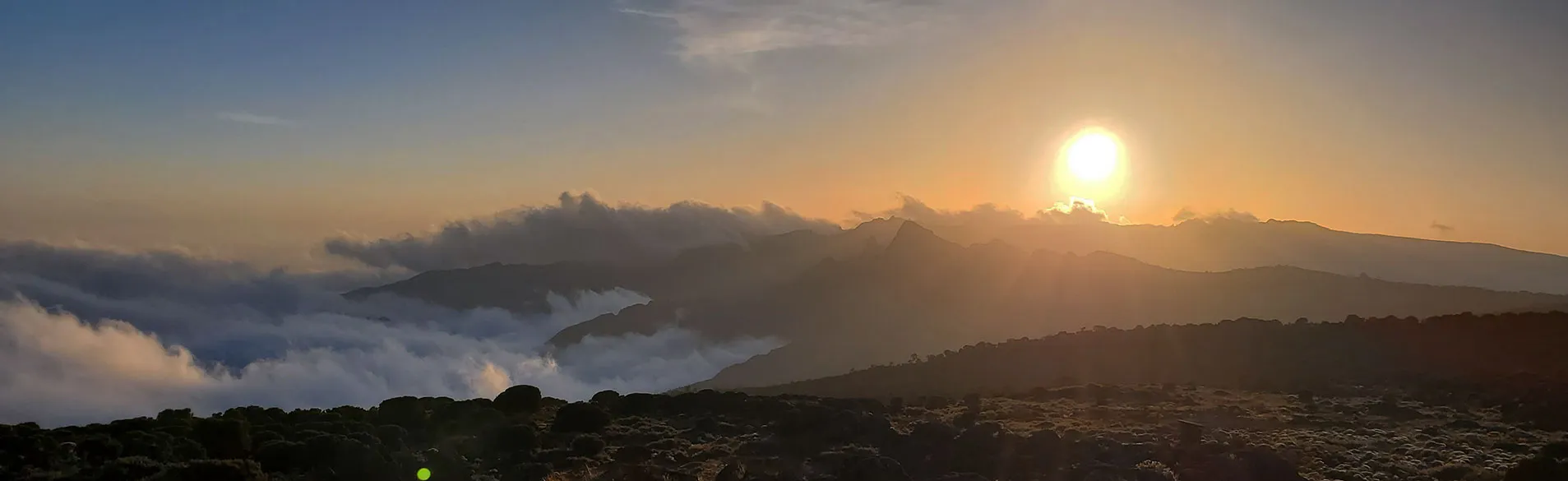
Across every route and itinerary length, roughly 65% of Kilimanjaro climbers reach Uhuru Peak. But that headline number hides the real story: climb a rushed 5-day itinerary and your odds drop below 40%; book an 8–9 day Lemosho or Northern Circuit plan and operators like Masatu Tours consistently summit 85–95% of their clients.
Kili stands at 5,895 metres (19,341 ft) and draws roughly 35,000–50,000 trekkers a year. You won't need ropes or crampons, but at nearly 6,000 m your body runs on about half the oxygen it's used to, and that single fact explains why summit outcomes swing so wildly depending on route, schedule, and preparation.
Summit Coach's Note
Ask any operator for a success rate, then ask whether that number means Uhuru Peak or the crater rim (Stella Point / Gillman's Point). Counting rim arrivals pads results by 5–10 percentage points.
Kilimanjaro Success Rate by Route, Quick Reference
All rates below target Uhuru Peak (5,895 m), not Stella Point or Gillman's Point. Data from Masatu Tours climb logs and current industry benchmarks.
| Route | Duration | Success Rate | Difficulty | Best For |
|---|---|---|---|---|
| Northern Circuit | 9 days | ~92% | Moderate | Max acclimatisation, solitude |
| Lemosho | 8 days | 90%+ | Moderate | First-timers, best scenery |
| Rongai | 7 days | 80–89% | Moderate | Rainy season, quiet trail |
| Machame | 7 days | 75–85% | Challenging | Experienced trekkers |
| Marangu | 6 days | 65–77% | Moderate | Hut preference |
| Umbwe | 7 days | 70–78% | Hard | Experienced only |
Always choose the longest available itinerary for each route, a 6-day Lemosho is significantly less successful than the 8-day version.
What Does "Summit Success Rate" Really Mean?
Put simply, the summit success rate is the share of climbers who make it all the way to Uhuru Peak (5,895 m), the actual top, not just the crater rim. You take the number who tagged Uhuru, divide by the total who started, and break it down by route, trip length, and season.
Why hammer this point? Because Kili has several "almost-summit" spots, and not everyone counts them the same way. Stella Point (5,756 m) sits on the crater rim about 45 minutes below Uhuru, and Gillman's Point (5,685 m) is the Marangu-side crater rim entry. Some operators quietly count reaching either of these as a "summit," which pads their numbers by 5–10 percentage points. We've seen brochures quoting 98% success, turns out they're counting Stella Point arrivals.
Ask These Three Questions
(1) Which summit point are they counting? (2) What itinerary lengths do they actually run? (3) Do they include every client, or just the ones who finished the full trek?
There's no live public scoreboard for Kili summits. KINAPA (Kilimanjaro National Park Authority) keeps gate logs and summit registers but doesn't publish them in real time. The freshest, most trustworthy data comes from established operators who track every climb and compare notes during industry reviews, see the official KINAPA page for park context.
What's the Real Kilimanjaro Summit Success Rate?
Let's be upfront: the official park numbers are old. KINAPA's last widely cited dataset is from the early 2000s. It's useful background, but if you want to know what's actually happening on the mountain today, you need current operator logs.
Older KINAPA Baseline (early 2000s, outdated)
- All routes and durations: 45%
- All 5-day itineraries: 27%
- All 6-day itineraries: 44%
- All 7-day itineraries: 64%
- All 8-day itineraries: 85%
Current Practical Ranges (modern operator logs)
- 8–9 day itineraries: 85–95%
- 7-day itineraries: 72–92%
- 6-day itineraries: 60–80%
- 5-day itineraries: 35–55% (not ideal for first-timers)
The Pattern Is Crystal Clear
More days on the mountain = dramatically better odds. It's not even close, duration beats fitness, gear, and almost everything else you can control.
Where Do These Numbers Actually Come From?
Kili doesn't have a centralized reporting system like you'd find in the Alps or the Rockies. Data quality boils down to how honest and consistent an operator is. Here's how we do it at Masatu Tours:
Daily progress logs
Guides record altitude gained, camp reached, health observations (pulse oximetry where available), and individual climber status at each checkpoint.
Summit point recording
Each climber's highest point is logged (Gillman's Point, Stella Point, or Uhuru Peak) along with time of arrival and physical condition.
Post-expedition reporting
Every trip generates a summary covering route, weather, health events, turn-back reasons, and summit outcomes.
Seasonal reviews
Operators compare success and failure patterns across dry and wet seasons to refine itineraries and guide training.
Honest reporting culture
Responsible operators report both summits and turn-backs with explanations. Inflating numbers undermines future planning and client trust.
How Masatu Uses This Data
We sit down with this data every quarter, not to pat ourselves on the back, but to find patterns. Where did people struggle? Was the pacing off? Did a particular week's weather mess with a route? That honest review is why our 8–9 day trips keep outperforming the wider industry numbers. We're a KPAP Partner Company committed to porter welfare and transparent reporting.
Kilimanjaro Success Rate by Route: Detailed Breakdown
Kilimanjaro has six main routes, and they're not created equal. Each one climbs the same mountain but through different terrain, at a different pace, and with very different summit odds. Here's what we see on each one.
Lemosho (8–9 days)
90%+The pick for a first-timer. It starts from the quiet western Londorossi Gate, threads through rainforest, and opens onto the Shira Plateau at 3,800 m. The 8–9 day schedule gives you textbook climb-high-sleep-low days with gains of just 500–700 m. You merge with the Machame trail at Lava Tower (4,630 m), tackle the Barranco Wall, and push for the summit from Barafu. All those days between 3,500–4,600 m are why Lemosho's numbers are so strong, a group of six last August, ages 28 to 61, all made Uhuru on the 8-day route.
Best for: First-time high-altitude trekkers, photographers, anyone prioritizing summit probability.
Northern Circuit (9 days)
~92%The longest and newest route. It follows Lemosho's western start but swings north, looping the entire back side of Kili through terrain most trekkers never see. That extra day on the quiet northern slopes is pure acclimatization gold. Nine days, the gentlest altitude gains of any route, and some of the highest success rates we've ever recorded. The catch? Cost, more nights in the park means higher fees, and you're genuinely remote if weather turns.
Best for: Those with budget flexibility who want maximum acclimatization and solitude.
Machame (6–7 days)
75–85%The Whiskey Route, Kili's busiest trail, and for good reason: dramatic, varied, and the 7-day version works well. The extra Karanga Valley day between Barranco and Barafu camps makes a huge difference; the 6-day version skips it, and we see the results in the turn-back numbers. The steep ups and downs, particularly the Lava Tower push to 4,630 m followed by the drop to Barranco at 3,976 m, give your body solid acclimatization training. It gets crowded in peak season.
Best for: Moderately fit trekkers who want varied terrain. Always choose the 7-day option.
Rongai (6–7 days)
80–89%Comes in from the northeast near the Kenyan border, the driest route on the mountain. If you're climbing in the wet season (March–May or November), this is the one we'd steer you toward. The 7-day version's gentle gradient delivers solid results, and while you won't get the jaw-dropping scenery of the western routes, Rongai makes up for it with reliable weather, barely any crowds, and a steady uphill that doesn't beat you up. One of our guides calls it the thinking person's route.
Best for: Wet-season climbers, quiet trails, trekkers who prefer a steady gradient.
Marangu (5–6 days)
65–77%The Coca-Cola Route, the only trail with hut accommodation, and that comfort factor draws a lot of first-timers. The problem: the standard 5-day schedule is simply too fast. Your body doesn't have time to adjust. The 6-day version adds an extra night at Horombo Hut (3,720 m) and the difference in success rates is stark. Marangu isn't harder than other routes, it's the rushed schedule that kills people's chances. Just know you go up and come down the same way.
Best for: Those who prefer hut accommodation. Always request the 6-day itinerary.
Umbwe (6–7 days)
70–78%The steep one. It goes straight up through dense forest, gains altitude fast, and doesn't apologize for it. It's the quietest route on the mountain, you might not see another group for hours, but that also means fewer support options if something goes wrong. Even on a 7-day schedule, the rapid altitude gain can catch people out. We'll be straight: Umbwe isn't for first-timers.
Best for: Experienced trekkers seeking challenge and solitude. Not recommended for first-timers.
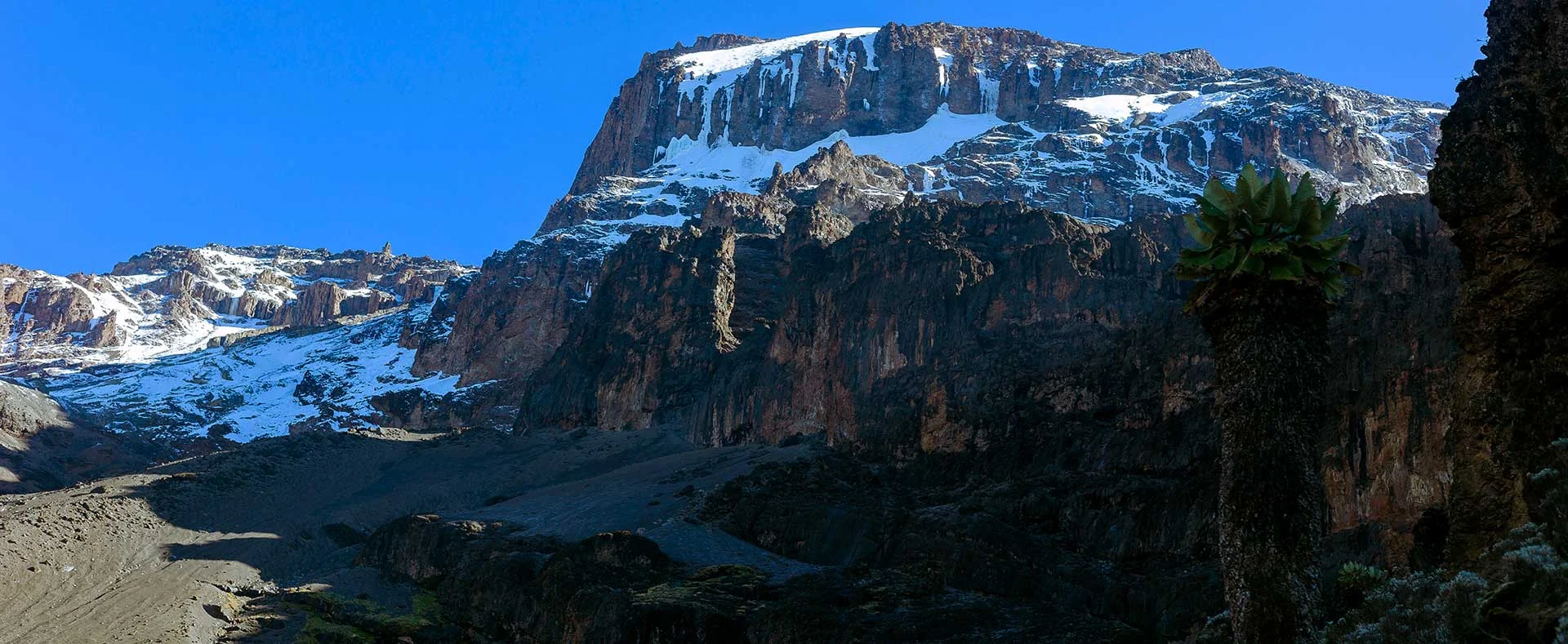
Main Factors Affecting Your Summit Chance
Itinerary Duration and Route
The biggest lever you can pull. More days = more time to acclimatize = dramatically better odds. Most evacuations happen on 5–6 day trips.
Route Profile
Lemosho and Northern Circuit have the best altitude profiles. Machame shines at 7 days. Umbwe? Leave that for people who've been above 5,000 m before.
Season / Time of Year
Dry season = clearer skies, warmer summit nights, and more predictable footing. You can climb in the wet months, but you'll need tougher nerves and waterproof everything.
Fitness and Acclimatization
Marathon runners turn back on day 4 while a 58-year-old grandmother who just does Sunday walks strolls to Uhuru. Fitness helps with comfort; pacing and hydration matter way more.
Age, Gender, and Personal Factors
Neither predicts success, we've summited people from 12 to 74. What matters is the route you pick, how honest you are about your health, and the decisions made on the mountain.
Team Organization and Guides
A good guide is your altitude coach, health monitor, and the person who makes the tough call if you need to turn back. That expertise directly affects your summit odds.
Equipment, Meals, and Comfort
Many summit bids fail because someone couldn't sleep or skipped meals. Good gear and proper camp food aren't luxuries, they're performance tools.
Honest Route Matching
Don't just pick the route your friend did. A 25-year-old trail runner and a 55-year-old weekend hiker need different plans. The right match matters.
Weather and the Unexpected
Sometimes the mountain says no, a freak storm, unexpected snowfall, or a health issue nobody could have predicted. That's mountaineering.
| Route | Recommended Duration | Typical Success | Notes |
|---|---|---|---|
| Lemosho | 8–9 days | 90%+ | Best all-round acclimatization profile |
| Northern Circuit | 9 days | ~92% | Longest route, excellent adaptation window |
| Rongai | 7 days | ~89% | Drier side of the mountain |
| Machame | 7 days | ~85% | Strong route if not rushed |
| Marangu | 6+ days | ~77% | Hut route; short versions underperform |
These are real-world ranges from current operator data. Your actual odds depend on weather, your specific group, and how the climb is managed.
Altitude Sickness and AMS: The Biggest Summit Killer
Here's the uncomfortable truth: Acute Mountain Sickness (AMS) causes roughly 75% of all summit failures on Kili. Not fitness. Not weather. Altitude. If you understand how it works and what to do about it, you're already ahead of most climbers who show up at the gate.
What Happens to Your Body at High Altitude
Above about 2,500 m, every breath gives you less oxygen. Your body fights back, heart rate rises, you breathe faster, and your bone marrow starts producing extra red blood cells. But that adaptation takes days, not hours. That's the whole reason longer itineraries work better: you're literally buying your body time to adjust. At the summit (5,895 m) you're breathing air with roughly 49% of the oxygen you'd get at sea level.
AMS Symptoms: What to Watch For
Mild AMS (common above 3,500 m)
- Headache (most common symptom)
- Nausea or reduced appetite
- Fatigue and dizziness
- Difficulty sleeping
Severe AMS (requires immediate descent)
- Persistent vomiting
- Ataxia (inability to walk straight)
- Confusion or altered consciousness
- Breathlessness at rest
How to Reduce AMS Risk
Pick a longer itinerary
8–9 day routes give your body the time it needs. There's no shortcut for red blood cell production, you either give it days or you don't.
Drink more water than feels reasonable
3–4 litres a day. Dehydration makes every AMS symptom worse and slows acclimatization. If you're not peeing clear, you're not drinking enough.
Pole pole (slowly, slowly)
You'll hear this Swahili phrase a hundred times on the mountain. Walk slower than you think you need to, if you can hold a conversation, you're at the right pace.
Talk to your doctor about Diamox
Acetazolamide can help prevent AMS if started before the climb. It's not magic, but many of our clients use it. Get a prescription before you fly.
Tell your guide the second you feel off
Don't tough it out. A headache at 3,500 m is a signal, not a weakness. Early intervention, slower pace, extra rest, a short descent, can save your entire summit bid.
Learn More
See our Diamox & altitude sickness guide and the CDC high-altitude guidance for full prevention detail.
Summit Night: The Final Push to Uhuru
Summit night is the moment of truth. Everything you've done for the past week, the training, the slow walking, the litres of water, the uncomfortable sleep, comes down to these 8 hours in the dark. It's the hardest thing most of our clients have ever done, and the most rewarding.
Your guide wakes you up. It feels absurd, you barely slept. Hot tea, maybe some biscuits. You layer up in the dark: headlamp, gloves, everything you've got. It's cold. Really cold.
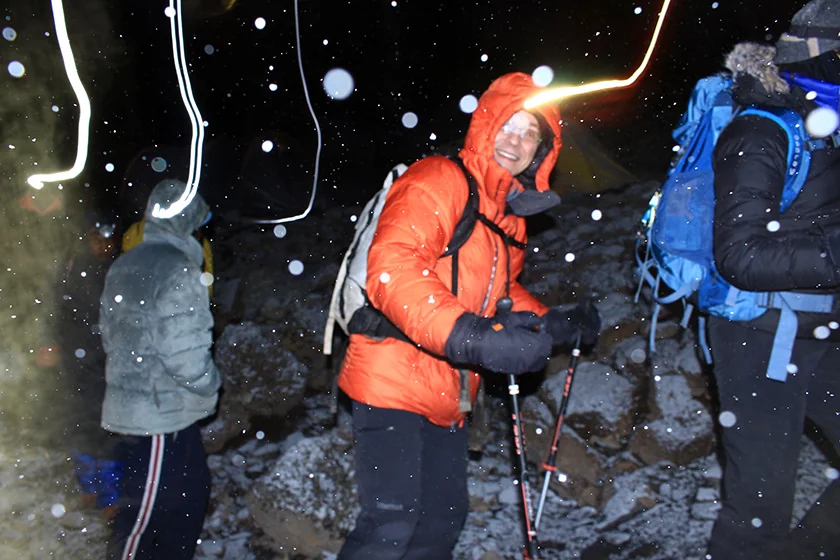
Into the darkness. Headlamp beams, loose scree underfoot, the sound of your own breathing. The pace is painfully slow on purpose. Temps can hit -15 to -25°C with wind chill. Your world shrinks to the next footstep. This stretch breaks people or makes them.
Dawn starts to glow. You hit Stella Point (5,756 m), the crater rim, and for the first time you can see where you are. If you've made it here, Uhuru is about 45 minutes of flat-ish walking along the rim. You're going to make it.
Uhuru Peak. 5,895 m. The sign. The glaciers. The sunrise painting everything gold. You've got maybe 15–30 minutes up there before altitude says it's time to go. Take the photos, feel it, breathe it in.
Then down. Fast. Your knees will have opinions about the 2,000+ m descent that follows. By afternoon you're at a lower camp, exhausted, elated, and wondering if that really just happened.
Why Summit Night Fails
Physical
Severe AMS, vomiting, total exhaustion, or real hypothermia/frostbite risk. When the body says stop, you stop.
Mental
Six hours of cold, dark, monotonous scree climbing with no visible progress. It breaks people, we've seen strong climbers sit down at 5,200 m and say they're done.
Weather
Storms blow in fast at that altitude. When visibility drops to zero and wind gusts threaten to knock you over, no summit is worth the risk.
Timing
Start too late or move too slowly and you won't have enough daylight to summit and descend safely. The mountain has a clock.
One strategy that helps with the mental challenge: time your summit for a full moon. Natural moonlight transforms the dark scree climb into something far more manageable and visually spectacular.
10 Proven Ways to Improve Your Summit Chances
After hundreds of climbs and years of post-trip reviews, these are the things that actually move the needle. No fluff, just what works:
Choose an 8–9 day itinerary
The single biggest thing you can do. Going from 6 to 8 days can boost your odds by 20–30 percentage points. Nothing else comes close.
Select Lemosho or Northern Circuit
Best acclimatization profiles, highest success rates. If your budget allows it, these are the routes to pick.
Train with hiking and elevation
Start 12–16 weeks out. Hike with a loaded pack (10–15 kg), do stairs, build your cardio. Summit night is 8+ hours of uphill in thin air, your legs need to be ready.
Hydrate relentlessly
3–4 litres a day, every day. Carry a hydration bladder so you can sip constantly. Drink even when you don't feel thirsty.
Climb during dry season
January–March and June–October give the best weather windows, warmer summit nights, solid footing, clear skies. It all adds up to better odds.
Book with an experienced operator
Your guide can make or break your climb. Experienced teams monitor health, control the pace, and know when to push and when to pull back.
Eat well on the mountain
Your body burns 4,000–6,000 calories a day up there. Good operators serve real meals, snack between them with trail mix and energy bars.
Invest in quality gear
A sleeping bag rated to -15 to -20°C, a proper layering system, boots that are broken in, and a reliable headlamp. If you skimp on gear, you'll pay for it at 2 AM on summit night.
Adopt the pole pole mindset
Walk slower than you think. The urge to keep up with the fast group is real, but burning energy early is how people end up turning back at 5,000 m. Trust your guide's pace.
Communicate with your team
Be honest with your guide. 'My head hurts a bit' at 4,000 m is useful information. 'I'm fine' followed by collapse at 5,200 m helps nobody. Early honesty saves summits.
When Things Don't Go to Plan
Turning Back Can Be the Right Decision
- • Significant altitude symptoms (persistent headache + vomiting, ataxia, confusion, breathlessness at rest)
- • Injury (sprain, fall, impact-related limitations)
- • Severe weather exposure risk
- • Mental collapse / inability to continue safely
No responsible operator chases a 100% stat. A well-timed turn-back isn't failure, it's good judgment. And it very often leads to a successful second attempt with better preparation.
Common Failure Patterns We See
Too-short itinerary
We see this constantly, someone books a 5-day trip, starts feeling rough at 4,000 m, and there's no rest day built in to recover. Game over.
Not drinking enough water
Less than 2 litres a day at altitude is asking for trouble. It accelerates every AMS symptom and drains your energy reserves.
Going too fast early on
The competitive types who blast through the first three days like it's a race, then have nothing left for summit night. We've watched it happen dozens of times.
Undisclosed health issues
A heart condition, respiratory problem, or medication interaction that nobody mentioned during booking. Altitude amplifies everything, please be upfront with us.
Gear that wasn't up to the job
Dead headlamp batteries at midnight, boots that haven't been broken in, or a jacket that's fine at sea level but useless at -20°C. These are avoidable problems.
Our guides run health checks twice a day using the Lake Louise AMS scoring system. If you score 5 or higher, we stop, rest, and reassess before anyone takes another step up. It's not negotiable, and it saves lives.
Didn't Make It? A Second Attempt Usually Works
Absolutely. A lot of our most satisfying summits are second attempts. People come back with a longer itinerary, better training, and the kind of mountain knowledge you only get from being there. The success rate on second attempts is significantly higher.
What changes everything
Longer route, slower pace, more pre-trip hiking, and actually drinking enough water this time.
The mindset shift
This isn't a do-over, it's a smarter plan with experience backing it up.
Second Attempt Success Data
Switched from a 6-day to an 8-day itinerary, this alone was the game-changer for most people
Picked a different route entirely, Machame 6 to Lemosho 8 is the most common swap we see
Actually trained this time, more hiking with real elevation, stronger cardio base
Took hydration seriously and ate properly on the mountain (sounds basic, makes a huge difference)
Timed the climb for dry season instead of wet
If your first attempt didn't work out, don't beat yourself up. Most turn-backs come down to correctable factors, usually itinerary length. Fix that, and you'll almost certainly make it the second time around.
Frequently Asked Questions
Final Thoughts: Buy Yourself Time on the Mountain
The formula isn't complicated: pick a good operator, take a long enough route, listen to your guide, and drink water like it's your job. Duration is the single biggest lever you control, every extra day on the mountain buys your body time it needs to adapt.
Whether you're planning a first attempt or coming back after a turn-back, the right route and schedule change your odds dramatically. The honest numbers are on your side if you plan for them.
Plan Your Summit Strategy
Tell us your dates, group size, and experience level, Masatu recommends the itinerary with the best success odds for you, with transparent pricing from a KPAP Partner Company. See it before you commit.
Continue Your Kilimanjaro Planning
How Long Does It Take?
Duration breakdown by route and acclimatisation needs
How to Prepare for the Climb
Operators, training, gear, and medical preparation
Training for Kilimanjaro
8–12 week conditioning plans for stronger ascent days
Diamox & Altitude Sickness
Medication and acclimatisation strategies explained
How Hard Is Kilimanjaro?
Altitude challenges and route difficulty compared honestly
Best Time to Climb
Month-by-month weather and optimal climbing windows
Uhuru Peak Guide
Facts, history, and reaching Africa's highest point
Get a Free Climb Quote
Personalised plan within 3 hours from our Moshi team
Last updated: August 2, 2026. Success rates reflect Masatu Tours climb logs plus widely referenced industry and KINAPA datasets. Your actual odds depend on weather, your specific group, and how the climb is managed, always confirm itinerary details with your operator before booking.
