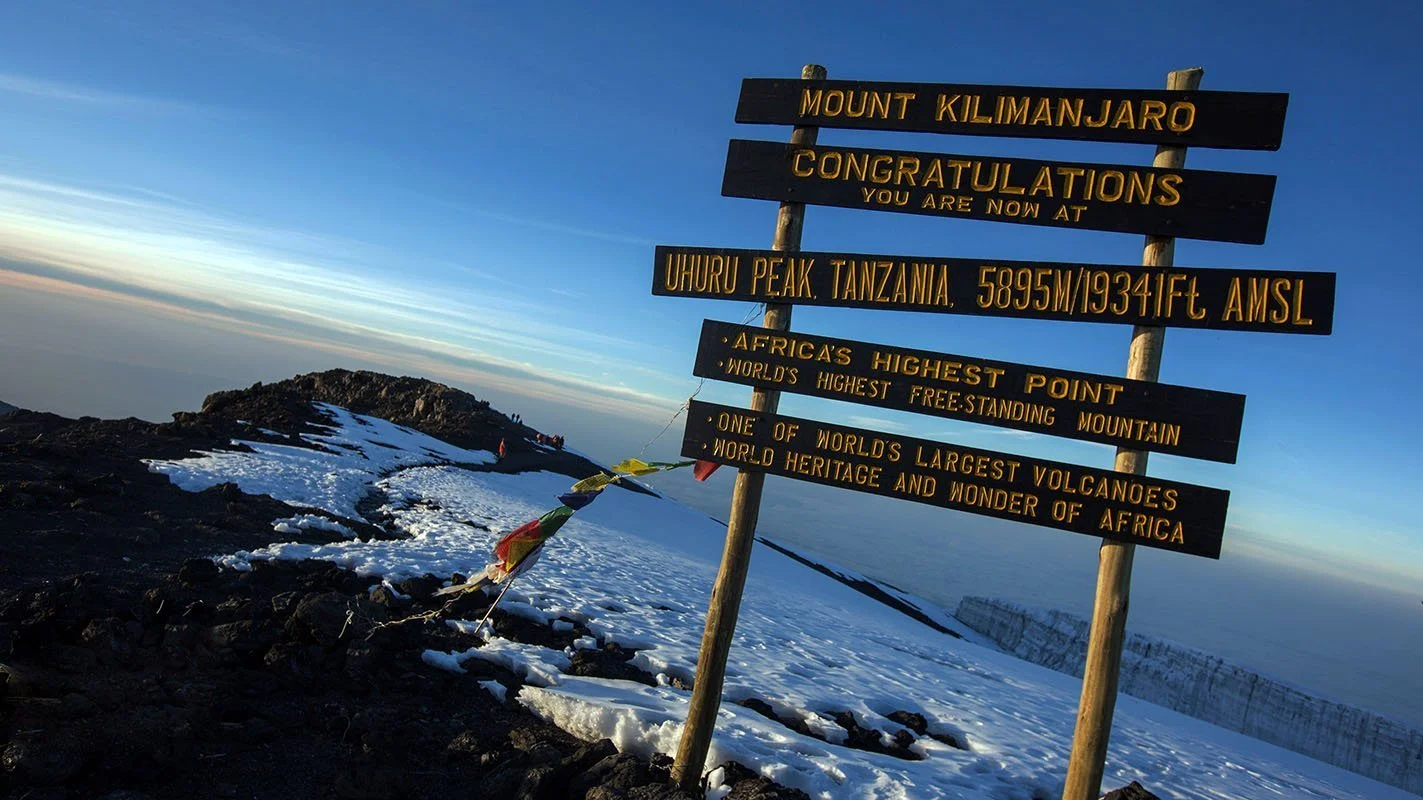
Uhuru Peak is the summit of Mount Kilimanjaro and the highest point in Africa. The iconic green signpost at the crater rim proclaims: "Congratulations! You are now at Uhuru Peak, Tanzania, 5,895 m / 19,341 ft AMSL", above mean sea level. Standing here, you are at the roof of Africa.
That rim overlooks the summit crater below, the Reusch Crater, named after the missionary who descended into it 25 times. Few of the 30,000+ climbers who stand at the signpost each year ever see what lies beneath it.
Kilimanjaro's summit is reached by trekking, no technical mountaineering, but altitude is the main challenge. Success depends far more on acclimatisation than fitness: choose a route and itinerary length that gives your body time to adapt.
Summit Coach's Note
More climbers are turned around by altitude than by fitness. On 7+ day itineraries, summit success rates climb above 85%, the extra nights are not optional extras, they are the strategy.
Uhuru Peak at a Glance
Altitude
5,895 m / 19,341 ft AMSL
Name Origin
Swahili for "freedom"
Location
Kibo cone, southern rim
Status
Africa's highest point
First Ascent
Meyer & Purtscheller, 1889
Success Rate
85%+ on 7–9 day treks
Summit Time
6–8 hrs from Barafu Camp
Climb Type
Non-technical trek
Elevation Details
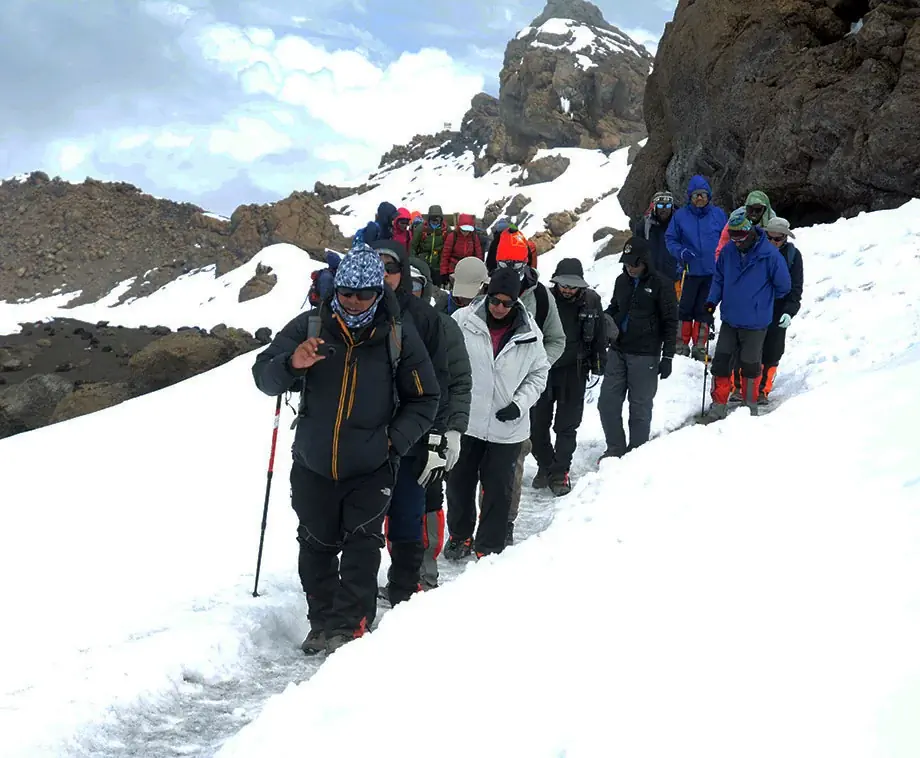
The official elevation of Uhuru Peak is 5,895 metres (19,341 feet) above mean sea level. This figure appears on the famous green summit signpost and is the measurement used by Kilimanjaro National Park.
Geodetic Fact
From certain measurements, Kilimanjaro's summit is farther from Earth's centre than Everest's summit, because Kilimanjaro sits near the equator, where the Earth bulges slightly. Not bad for a mountain you climb by walking.
Why "Uhuru"?
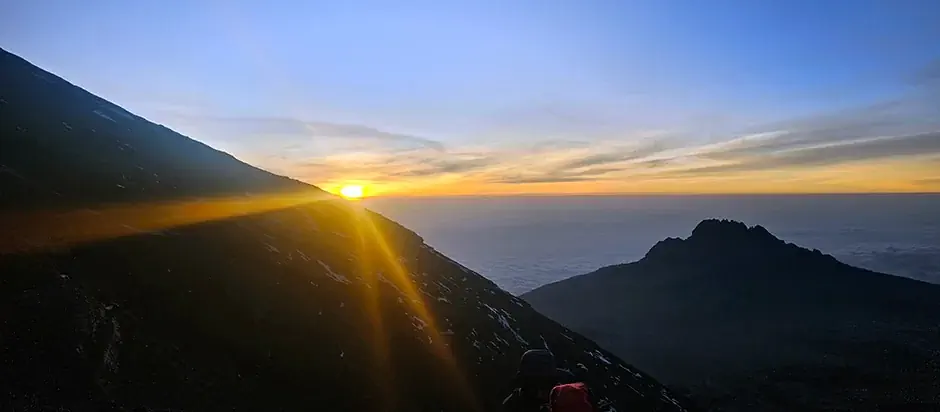
"Uhuru" means "freedom" in Swahili. The peak was renamed Uhuru Peak in December 1962 to commemorate Tanganyika's, later Tanzania's, independence. The new name replaced the colonial-era designation "Kaiser Wilhelm Peak".
The Uhuru Torch (Mwenge wa Uhuru) was first lit on Kilimanjaro in the early 1960s as a national symbol of freedom and unity.
Today, the phrase "Uhuru na Umoja" (Freedom and Unity) appears on Tanzania's coat of arms.
Historical Timeline
The first recorded ascent to Kibo's rim, the present Uhuru Peak signpost area, was on 6 October 1889 by the expedition led by Hans Meyer with Ludwig Purtscheller, climbed with local porters and helpers.
1889, Kaiser Wilhelm Peak
Hans Meyer and Ludwig Purtscheller reached the summit on 6 October, naming it Kaiser Wilhelm Peak in honour of the German Emperor.
1962, Uhuru Peak
After independence, the summit was officially renamed Uhuru Peak, and the Uhuru Torch was symbolically lit, marking a new era of freedom and unity for Tanzania.
Climatic Zones on Kilimanjaro
Kilimanjaro's altitude spans five distinct climatic zones, from tropical forest to arctic summit. Each zone presents unique landscapes and challenges:
Montane Forest
Hot, lush rainforest with unique flora and fauna
Heather & Moorland
Otherworldly vegetation adapted to altitude
Alpine Desert
Barren, dramatic landscapes with sparse vegetation
Arctic Summit
Extreme conditions above 5,000 m with receding glaciers
Glaciers Retreating Fast
Kibo's glaciers are retreating rapidly. Scientists estimate much of the ice could disappear within decades, when you climb, you are seeing a landscape changing fast. Another reason to visit responsibly and leave no trace.
Essentials to Reach Uhuru Peak
All trekking routes converge near the summit. Your choice of route and itinerary length is the single biggest factor in whether you reach the signpost:
Route Selection
Machame (6–7 days), Lemosho (7–8 days), Marangu (5–6 days), Rongai (6–7 days), or Northern Circuit (8–9 days), longer routes mean higher success rates.
Acclimatisation
Choose 7+ day itineraries, follow "climb high, sleep low", stay hydrated, and keep the pace pole pole. Altitude sickness is the most common turnaround reason.
Physical Preparation
Build cardiovascular endurance, train with a loaded backpack on hills, and start 3–6 months out. Focus on leg strength and core stability.
Gear Essentials
Summit night can hit -20°C. Pack a 4-season sleeping bag (-15°C rating), insulated jacket, broken-in boots, trekking poles, headlamp, and insulated hydration.
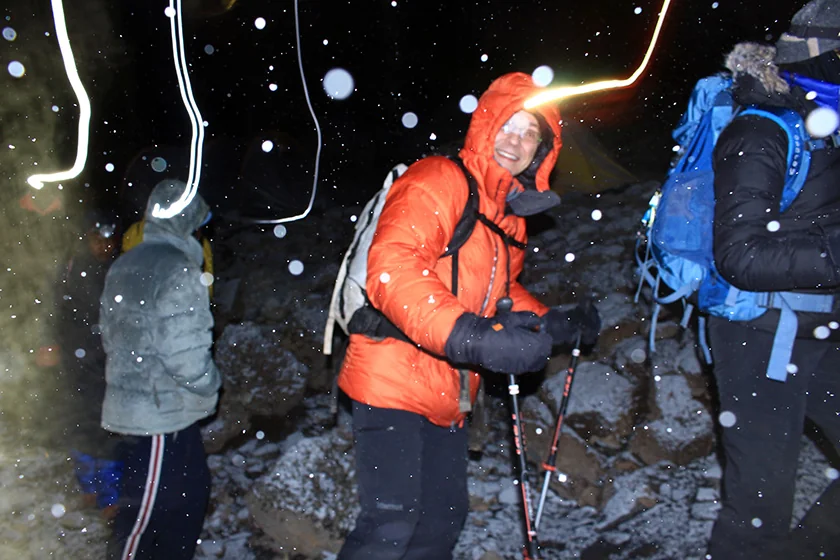
On the most popular routes, the summit push ends with two milestones: first reaching the crater rim at Stella Point (5,756 m) and then the final walk along the rim to the Uhuru signpost.
Certificates and Records
Park Certificate: Official Kilimanjaro National Park certificate with your name and summit date.
Operator Certificate: Many operators provide additional commemorative certificates.
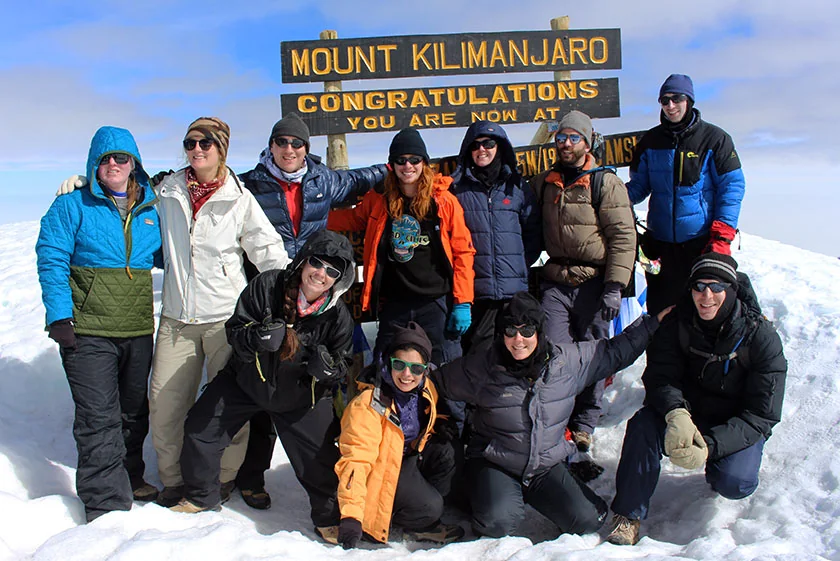
Summit Photo: The iconic photo at the green Uhuru Peak signpost, your proof for life!
Records: Climbers can register with the Seven Summits community.
Summit Etiquette
Photo Etiquette at the Summit
The summit can be crowded during peak season. Be considerate with photo time, aim for 5–10 minutes max at the signpost so everyone gets their moment.
Respect others: don't hog the signpost, share the moment.
Celebrate quietly: avoid loud noise that disturbs others.
Leave no trace: pack out all trash, including tissues and wrappers.
Thank your crew: acknowledge the guides and porters who made it possible.
Fun Trivia About Uhuru Peak
From certain measurements, Kilimanjaro's summit is farther from the Earth's centre than Everest's summit because it sits near the equator.
Tens of thousands attempt to stand on Uhuru each year, success depends on acclimatisation and weather, not just fitness.
The summit sign proclaims Kilimanjaro the "World's highest free-standing mountain", one of the peak's famous claims to geographic fame.
Further Reading
Frequently Asked Questions
Conclusion: Stand at the Roof of Africa
Uhuru Peak is more than a summit, it is a symbol of freedom, a geographic landmark, and the achievement of a lifetime. Reaching it takes no ropes or crampons, only sensible acclimatisation, honest fitness, and patience.
Choose a route with enough days, follow the golden rule of "climb high, sleep low", walk pole pole, and trust your guides. Then the most photographed signpost in Africa is yours.
Ready to Reach Uhuru Peak?
Tell us your preferred dates, fitness level, and whether you want a private or group expedition. Masatu recommends the right route, prepares your climb plan, and reserves your place, pole pole, we'll get you to Uhuru Peak safely.
Continue Your Kilimanjaro Journey
How to Prepare for the Climb
Operators, training, gear, and medical preparation
Kilimanjaro Costs
Complete cost breakdown and budget planning guide
How Long Does It Take?
Duration breakdown by route and acclimatisation
Is Kilimanjaro Difficult?
Honest difficulty assessment for first-time climbers
Ultimate Packing List
Complete gear checklist and layering strategy
Porter Tipping Guide
Fair tipping for guides, cooks, and porters
When to Avoid Climbing
Rainy season months and weather patterns
Get a Free Climb Quote
Personalised plan within 3 hours from our Moshi team
Last updated: August 2, 2026. Facts verified against Kilimanjaro National Park records, TANAPA guidance, and historical climbing literature.
